
U.S. purchase guide

Which Cardamom Should You Buy? Green Pods vs Ground vs Black Cardamom

Three U.S.-available cardamoms compared by botanical genus, whole pod vs ground format, origin, unit price per ounce, and recipe application.
Published Updated Market: United StatesBy
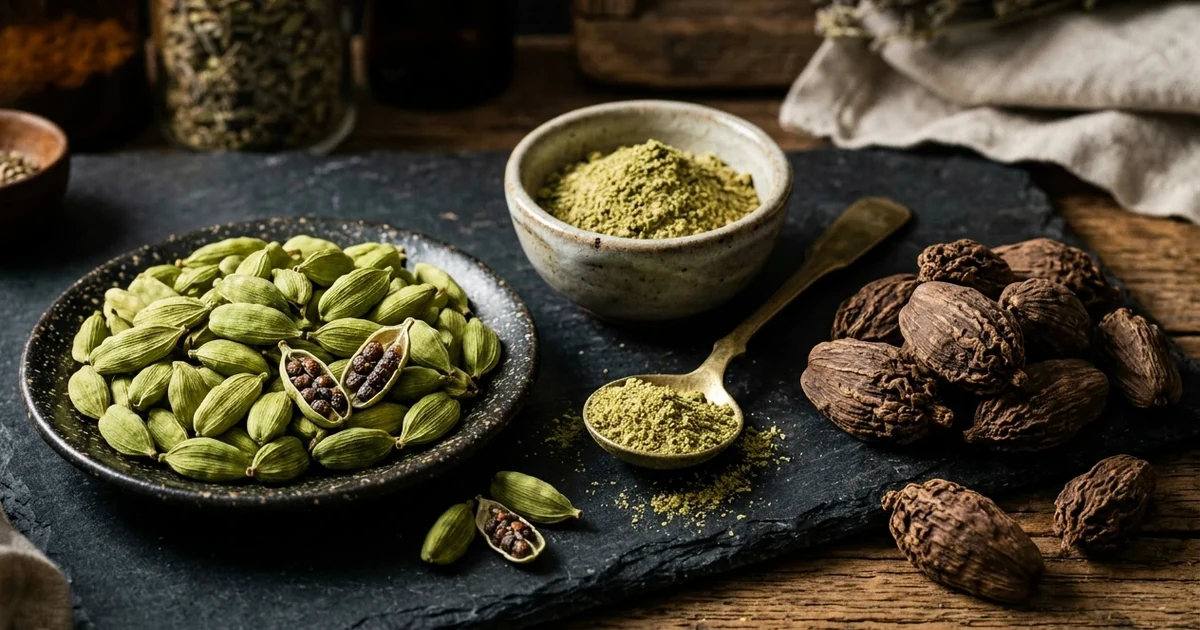
Three unlabelled bowls displaying whole green cardamom pods, smoky black cardamom pods, and ground spice on dark slate
Cardamom encompasses two separate botanical genera: bright eucalyptus-floral green pods (Elettaria) and smoky, resinous black pods (Amomum). Image: The Foods That Shaped Us Research Desk. Image terms. Request permission.

Purchase verdict

For sweet baking, Scandinavian pastries, spiced coffee, and masala chai, whole green cardamom pods (Elettaria cardamomum) from Burlap & Barrel provide maximum essential oil retention and bright floral cineole aroma when freshly cracked. Spicewalla ground green cardamom offers convenient immediate dispersion for rubs and batters, though pre-ground oils volatilize rapidly once opened. The Spice House whole black cardamom (Amomum subulatum) is a completely different, smoke-cured botanical spice designed exclusively for slow-cooked savory stews, curries, and biryanis. These are botanical and processing distinctions, not a sensory ranking.

Track this category through time

Quick choices

Observed prices are U.S. snapshots from August 30, 2026. Seller links are direct and non-affiliate.

Product choices, documented use, observed U.S. price, package size, unit price, and seller
ProductDocumented fitObserved priceSeller
Burlap & Barrel Cloud Forest Cardamom Pods (Whole Green)Whole cured green cardamom pods (Elettaria cardamomum); 1.6 oz (45 g) jarFor bakers, coffee brewers, and chai makers seeking whole green cardamom with intact seeds and high essential oil content.$12.991.6 oz$8.12 per ozAvailable when checkedCheck Burlap & BarrelVerified 2026-08-30
Spicewalla Cardamom, Green PowderFinely ground green cardamom seed powder; 1.8 oz tinFor cooks who need finely milled green cardamom for immediate blending into dry cake flour, cookie doughs, and quick spice rubs.$14.991.8 oz$8.33 per ozAvailable when checkedCheck SpicewallaVerified 2026-08-30
The Spice House Whole Black Cardamom Pods (Badi Elaichi)Whole smoke-dried black cardamom pods (Amomum subulatum); 1.5 oz glass jarFor slow-simmered savory South Asian and Himalayan dishes, including biryani, rogan josh, dal makhani, and pho broth.$11.991.5 oz$7.99 per ozAvailable when checkedCheck The Spice HouseVerified 2026-08-30

Where to buy in the U.S.

These direct, non-affiliate seller pages were checked on August 30, 2026. Stock, shipping, taxes, and checkout prices can vary by location and date.

How products were selected

  • We selected products with a manufacturer-controlled U.S. product page, a readable ingredient list, a stated package size, and a price observed on August 30, 2026.
  • The comparison separates documented botanical classification and processing methods from sensory judgments. The Research Desk has not completed a side-by-side taste test of these spices.
  • Unit prices use the observed single-jar price before shipping, tax, subscriptions, bundles, or checkout discounts.

Product evidence

documented only

Burlap & Barrel Cloud Forest Cardamom Pods (Whole Green)

Whole cured green cardamom pods (Elettaria cardamomum); 1.6 oz (45 g) jar

Check seller

For this use: For bakers, coffee brewers, and chai makers seeking whole green cardamom with intact seeds and high essential oil content.

Ingredients documented
100% whole green cardamom pods (Elettaria cardamomum).
Stated origin / claims
Harvested in the cloud forests of Alta Verapaz, Guatemala.; Non-irradiated; Direct trade claim; Non-GMO claim
Suitable uses
Crushed into Turkish/Arabic coffee and masala chai; Scandinavian cardamom buns (kardemummabullar); Kheer, rice pudding, and custard desserts
Allergens to check
Check the current package and facility statement.

Documented advantages

  • Whole closed pods protect delicate volatile oils (terpinyl acetate and 1,8-cineole) until cracked
  • Naturally air-cured green color without sulfur bleach treatments
  • Direct trade sourcing from Guatemalan cloud forest cooperatives

Limitations

  • Requires cracking and discarding husks before grinding or infusing
  • High unit price per ounce reflecting single-origin cloud forest sourcing
  • Whole pods must be strained out when used whole in liquids

documented only

Spicewalla Cardamom, Green Powder

Finely ground green cardamom seed powder; 1.8 oz tin

Check seller

For this use: For cooks who need finely milled green cardamom for immediate blending into dry cake flour, cookie doughs, and quick spice rubs.

Ingredients documented
Pure ground green cardamom (Elettaria cardamomum).
Stated origin / claims
Sourced from India and Guatemala.; Non-GMO claim; Kosher certified
Suitable uses
Cakes, quick breads, and shortbread cookies; Dry spice rubs for poultry and lamb; Smoothies and breakfast oat bowls
Allergens to check
Check the current package and facility statement.

Documented advantages

  • Ready to measure without pod cracking or mortar-and-pestle grinding
  • Packaged in airtight metal tin to reduce light degradation
  • Even dispersion in dry baking mixtures

Limitations

  • Pre-ground cardamom loses top aromatic volatiles much faster than whole pods
  • Cannot be used where whole pod infusion is required
  • Highest unit price per ounce in this comparison

documented only

The Spice House Whole Black Cardamom Pods (Badi Elaichi)

Whole smoke-dried black cardamom pods (Amomum subulatum); 1.5 oz glass jar

Check seller

For this use: For slow-simmered savory South Asian and Himalayan dishes, including biryani, rogan josh, dal makhani, and pho broth.

Ingredients documented
100% whole black cardamom pods (Amomum subulatum).
Stated origin / claims
Grown in the Himalayan foothills of India and Nepal; wood-smoke cured.; Non-GMO claim; Kosher certified
Suitable uses
Biryani, pulao, and fragrant rice pots; Rogan josh, korma, and rich meat curries; Vietnamese pho and slow beef broths
Allergens to check
Check the current package and facility statement.

Documented advantages

  • Authentic smoke-cured camphor and resin profile essential for regional savory cooking
  • Lowest unit price per ounce in this comparison
  • Thick fibrous pod withstands hours of vigorous braising without disintegrating

Limitations

  • Completely unsuitable for sweet desserts, pastries, or sweet chai
  • Intense smoky camphor note can overwhelm light vegetable dishes
  • Seeds are difficult to crush without a heavy spice grinder

What to check on the label

  • Distinguish the botanical genus: Green cardamom is "Elettaria cardamomum", whereas black cardamom is "Amomum subulatum". They are not interchangeable substitutes in recipes.
  • Check format: Whole closed pods retain volatile essential oils (limonene, terpinyl acetate, cineole) for up to two years, while pre-ground powder begins losing aroma within weeks of exposure to air.
  • Inspect pod color: Naturally dried green cardamom is pale olive to sage green. Artificially bright neon green pods are often treated with sulfur dioxide fumes during processing.
  • Check origin: Guatemala is the world’s largest commercial exporter of green cardamom, while southern India (Kerala/Western Ghats) is the native botanical center known for high-oil Malabar and Mysore varieties.

Green vs black cardamom: Two distinct spices with different culinary roles

Despite sharing the common English name "cardamom," green cardamom (Elettaria cardamomum) and black cardamom (Amomum subulatum) represent distinct botanical genera with fundamentally different chemical profiles and culinary purposes [1][3]. Green cardamom pods are small, smooth, and papery, containing sweet, cooling, citrus-and-eucalyptus volatile oils dominated by terpinyl acetate and 1,8-cineole. This delicate aroma makes green cardamom the universal choice for sweet Scandinavian yeast buns, Indian sweets (kheer, gulab jamun), and fragrant spiced coffee [1][4].

In contrast, black cardamom pods are large, dark brown, deeply ribbed, and dried over open wood fires in Himalayan regions [3]. The drying process imparts an intense smoky, earthy, and camphoraceous aroma dominated by high concentrations of 1,8-cineole without the sweet floral esters of green cardamom. Black cardamom is used strictly as a whole spice in slow-braised savory dishes—such as biryanis, rogan josh, and rich meat broths—where prolonged simmering tempers its resinous smoke [3][5].

Whole pods vs pre-ground powder: Managing volatile essential oils

Cardamom seeds contain up to 8% volatile essential oils enclosed within a protective fibrous outer capsule. As soon as the pod is cracked and the seeds are ground into powder, these delicate terpenes and esters rapidly evaporate and oxidize upon contact with atmospheric oxygen [2][4]. For this reason, pre-ground cardamom purchased in grocery stores often smells flat, dusty, or medicinal compared to freshly cracked pods.

For recipes where maximum aroma is critical—such as chai or bakery doughs—purchasing whole green pods and crushing the dark inner seeds in a mortar immediately before cooking yields dramatically superior aroma [1]. If purchasing pre-ground cardamom for baking convenience, select tins with tight inner seals and use the spice within two to three months of opening [2].

The history behind the purchase

Cardamom is native to the wet evergreen rainforests of the Western Ghats in southern India, a region historically known as the Cardamom Hills. The spice traveled ancient maritime Silk Road routes to the Middle East and Mediterranean, eventually reaching Scandinavia via Viking trade connections with Constantinople. The full Cardamom history article traces that epic trade journey; this buying guide evaluates current United States retail choices, whole versus ground packaging, and botanical varieties.

Read the full history of Cardamom

Sources and price records

  1. [1]Cloud Forest Cardamom Product Details. Burlap & Barrel (2026).
  2. [2]Green Cardamom Powder Specifications. Spicewalla (2026).
  3. [3]Black Cardamom Pods Product Details. The Spice House (2026).
  4. [4]Cardamom: Production, Chemistry, and Technology. Indian Spices Board / Ministry of Commerce (2024).
  5. [5]ISO 882-1: Cardamom Specification. International Organization for Standardization (2021).
🏛️

Written by The Foods That Shaped Us Research Desk

The Foods That Shaped Us Research Desk is the publication byline for collaboratively maintained food-history articles, Case Files, Trend Desk analysis, and original Recipe Desk development. Historical work is grounded in cited sources. Recipes use measured formulations and receive an editorial consistency, safety-note, and image-provenance review before release.

Source-led editorial process·Read our Editorial Standards