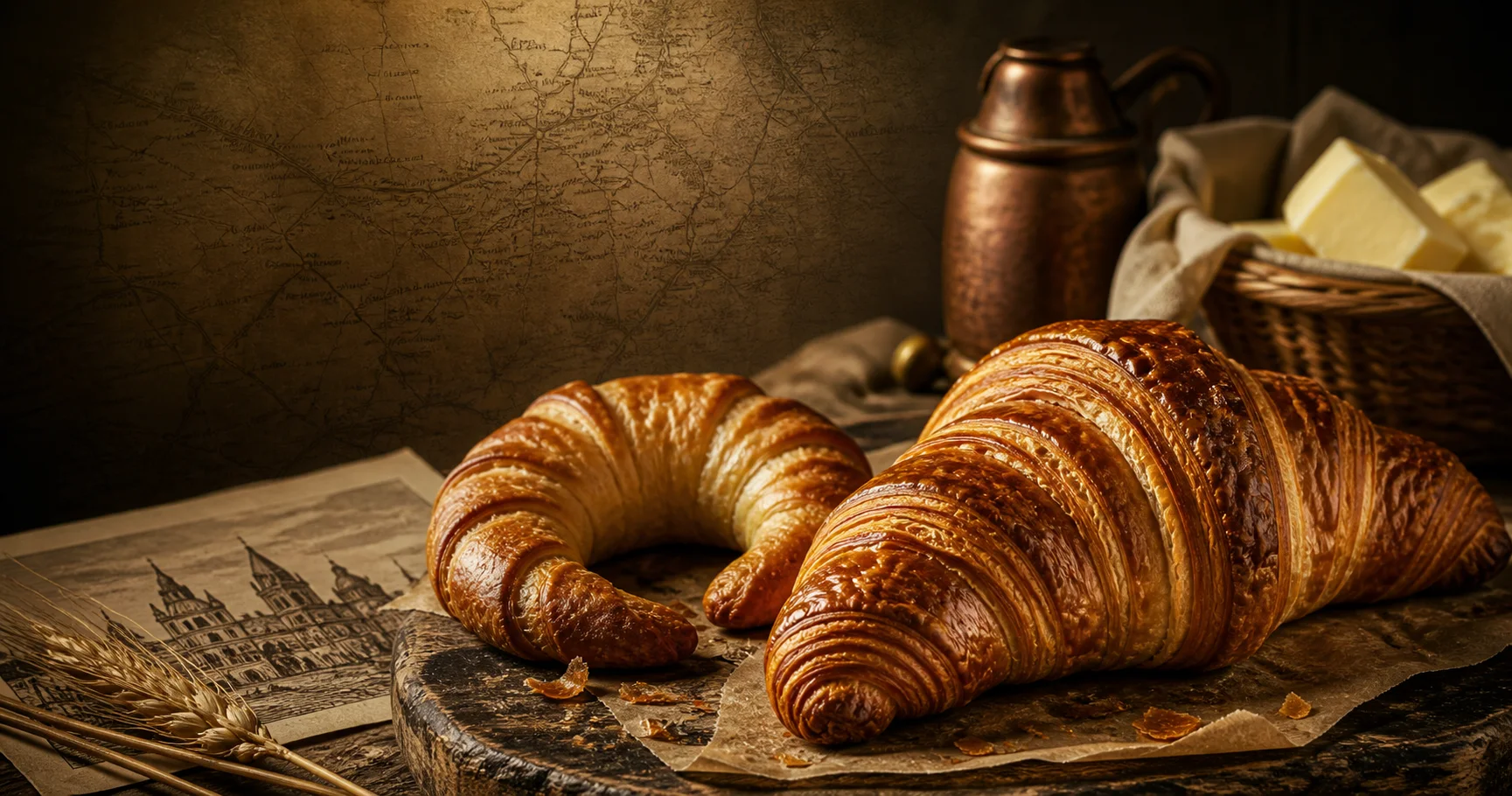
The 1683 Vienna Siege and the Croissant: A Bakery Legend Debunked
Brand and storytelling context review: Ahmed Baakli — Reviewed against cited public sources for: Croissant origin myths, Austrian kipferl, the Vienna siege legend, and French bakery branding.
Review lanes show the scope checked for this case file. Active standalone case files present source-led historical context.
Did bakers really invent the croissant after the 1683 siege of Vienna?
Verdict: The 1683 Vienna siege origin story — and the related Marie Antoinette version — is a popular bakery legend with weak documentation, not verified history. The documented route runs through the Austrian kipferl and August Zang's 1830s Paris bakery, not through a siege victory. [1] [2] [3] [4]
Why it matters: The croissant's most famous origin story is a myth, which shows how bakery legends harden into national identity. Separating the documented adaptation from the patriotic legend is exactly what source-led food history is for.
A Crescent With Austrian Roots
The croissant is a crescent-shaped pastry, and its shape descends from the Austrian kipferl, a crescent baked good documented in Vienna long before the modern French croissant. [1]
The croissant is a crescent-shaped pastry, and its shape descends from the Austrian kipferl, a crescent baked good documented in Vienna long before the modern French croissant. The French word croissant simply means crescent, which describes the shape rather than a French origin.
This is the basic correction behind the case file. The pastry now treated as the icon of the French breakfast is, in its earlier form, an Austrian baked good that French bakers adopted and reshaped.
The 1683 Siege Legend
The most famous origin story says that Viennese bakers, working before dawn during the 1683 Ottoman siege of Vienna, heard enemy tunneling under the city and raised the alarm. [1]
The most famous origin story says that Viennese bakers, working before dawn during the 1683 Ottoman siege of Vienna, heard enemy tunneling under the city and raised the alarm. To celebrate, bakers made crescent-shaped rolls mocking the Ottoman flag. A related legend says Marie Antoinette brought kipferl from Vienna to France.
These stories are widely repeated but poorly documented. Food historians treat the siege origin and the Marie Antoinette version as legend rather than verified history, which is why a source-led page should present them as stories, not facts.
August Zang and the Paris Bakery
A more documented link is August Zang, an Austrian artillery officer who opened a Viennese bakery, Boulangerie Viennoise, in Paris in the 1830s. [1]
A more documented link is August Zang, an Austrian artillery officer who opened a Viennese bakery, Boulangerie Viennoise, in Paris in the 1830s. His bakery helped introduce Viennese baking methods, including kipferl-style crescents and puff-pastry technique, to French consumers.
This is the strongest documented route by which the kipferl entered French baking. From there, French bakers gradually turned the Austrian crescent into a distinctively French pastry.
How France Made It Laminated
The laminated, buttery, flaky croissant known today is not the original kipferl. [1]
The laminated, buttery, flaky croissant known today is not the original kipferl. It developed in the 19th and 20th centuries as French bakers applied puff-pastry and butter-lamination techniques to the crescent shape. That step depended on butter becoming cheaper and more standardized, which links the croissant to the history of butter and pastry economics.
The verdict is not that France stole the croissant. It is that the croissant is a French adaptation of an Austrian pastry, and the siege story is a legend attached later. Source-led food history keeps the adaptation and the myth separate.
Claim Graph
Evidence-Backed Claims
Each conclusion below carries a machine-resolvable proof path to the cited sources listed at the bottom of this page.