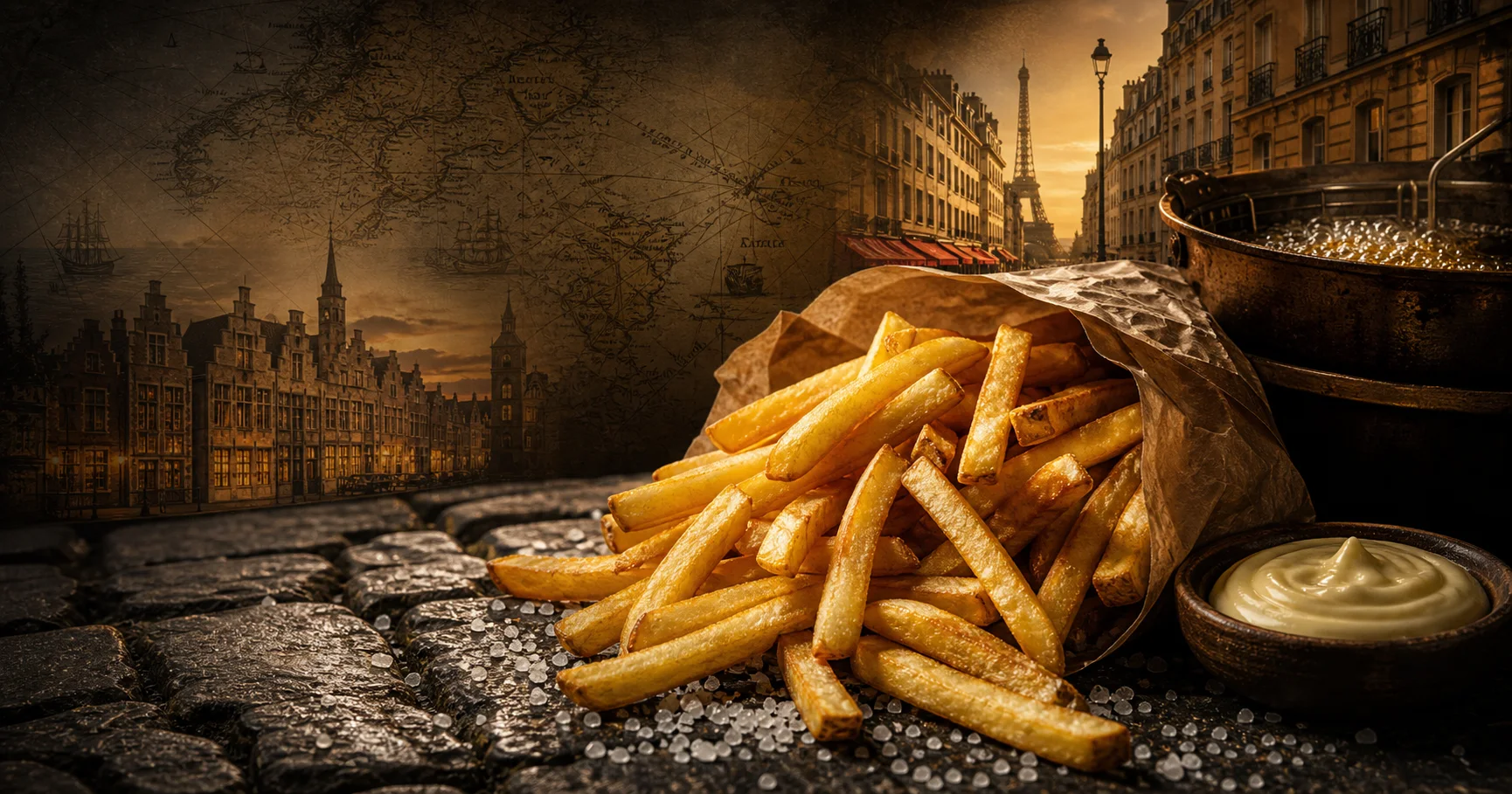
The History of the French Fry: France, Belgium and the Origin Debate
Source and factual review: Mehdi Iarab — Reviewed against cited public sources for: Belgian and French fried-potato claims, earliest documentary evidence, the English name, Jefferson, and U.S. popularization.
Review lanes show the scope checked for this case file. Active standalone case files present source-led historical context.
Where did French fries originate?
Verdict: The origin of French fries is disputed. Belgium has the most famous origin claim, while France also has early documented traditions of fried potatoes. The modern story is less clear-cut than the name “French fries” suggests. [1] [2] [3] [5] [7] [8]
Why it matters: Searchers asking where French fries came from, whether they are Belgian or French, and why they are called French fries are asking one historical problem. A patriotic shortcut loses the evidence, and a name is not the same thing as an inventor.
Where did French fries originate?
The origin of French fries is disputed. [2]
The origin of French fries is disputed. Belgium has the most famous origin claim, while France also has early documented traditions of fried potatoes. The modern story is less clear-cut than the name “French fries” suggests.
Potatoes are not native to Europe. They were domesticated in the Andes and reached European kitchens after the Columbian Exchange, so a fried potato in Paris or Namur cannot be a medieval French or Belgian invention [2][3]. The useful question is narrower: once potatoes were ordinary in Western Europe, where did the public habit of frying them into strips take hold, and why did English speakers call the result French fries?
Were French fries invented in Belgium or France?
Belgium did not invent the potato, and France did not receive an uncontested patent on frying it. [1]
Belgium did not invent the potato, and France did not receive an uncontested patent on frying it. Belgian public culture treats frites as a national food, with friteries, paper cones, sauces, and a double-cooking method that Belgians defend as the proper fry [1]. That is real culinary history. It is not the same thing as a single inventor in a single town.
France’s claim is strongest where the paperwork is strongest: late-18th- and early-19th-century Paris, where street vendors and cooks had fat, customers, and a market for fried foods [5][6][7]. Early Parisian fried potatoes were not always the long rectangular baton sold as French fries today; some recipes describe slices or small cuttings. Belgium later made the frite iconic. France left an urban documentary trail. Source-led history can hold both without declaring a winner the archives cannot support.
What is the earliest evidence for French fries?
The earliest evidence is not the most famous story. [5]
The earliest evidence is not the most famous story. The Belgian Meuse Valley legend — families frying river fish, then carving potato strips when the river froze, often dated around 1680 near Namur — is widely repeated and culturally important [1]. Food historian Pierre Leclercq has shown why it should be handled as folklore: potatoes were not yet established in that region at the legendary date, and deep-frying fat was costly for poor rural households [5].
A more cautious earliest layer is the commercial food world of Paris. Louis-Sébastien Mercier’s Tableau de Paris remains a witness to that street economy, and later culinary historians follow fried potatoes through Parisian vendors, kitchens, and restaurants [6][7]. Thomas Jefferson’s early-1800s notes on pommes de terre frites à cru en petites tranches document fried potatoes in small cuttings after his time in France, which is useful American evidence of a French preparation — not a European origin date [8]. The honest earliest picture is therefore layered: Andean potato, European adoption, Parisian fried-potato commerce, Belgian national fry culture, and a later English name.
Why are they called French fries?
They are called French fries in American English even though Belgium is the country most associated with frites. [3]
They are called French fries in American English even though Belgium is the country most associated with frites. The word “French” in “French fried potatoes,” which appears in English in the 19th century, more securely describes a cut or a frying method than it names France as the birthplace [2][3][4]. Culinary English used “French fried” for foods fried in the French manner; it did not require a Paris inventor.
A second naming path is wartime. U.S. soldiers eating frites in French-speaking Belgium during World War I had a ready English label for a dish they met in a Francophone setting [1][4]. That helps explain why Americans say French fries while Belgians say frites and the British often say chips. Are French fries French? The name is French-influenced. The origin debate is Belgian and French at once, and the American wording should not be mistaken for a verdict.
Did Thomas Jefferson introduce French fries to America?
Thomas Jefferson did not invent French fries, and the safer reading is that he did not single-handedly introduce them to America either. [8]
Thomas Jefferson did not invent French fries, and the safer reading is that he did not single-handedly introduce them to America either. Monticello’s historians note that Jefferson helped popularize several foods he encountered in France, including fried potatoes described as pommes de terre frites à cru en petites tranches — deep-fried potatoes in small cuttings [8]. That is an important early United States reference to a French fried-potato dish.
It is not a founding myth. Jefferson’s household was elite, the preparation may not match the modern long fry, and fried potatoes could travel through cooks, restaurants, and print without needing one famous importer. Treat Jefferson as evidence that a French fried-potato dish was known in the early United States, not as the man who brought French fries to the country.
When did French fries become popular in the United States?
French fries did not become an American staple in Jefferson’s lifetime. [4]
French fries did not become an American staple in Jefferson’s lifetime. The phrase “French fried potatoes” belongs to 19th-century English print; the mass habit belongs to the 20th century, when restaurants, diners, and later fast-food fryers made a fried potato strip ordinary rather than a French or Belgian curiosity [2][3][4]. World War I helped Americans meet Belgian frites under a French-sounding name. Later industrial frying, cheap potatoes, and chain restaurants turned that name into a default side dish.
The food-history point is the lag. Origin debates are about early European frying. Popularity in the United States is about restaurants, language, and scale. Those are consecutive chapters, not the same event.
French fries origin timeline
A responsible French fries origin timeline is a sequence of documented layers, not a single birthday. [2]
A responsible French fries origin timeline is a sequence of documented layers, not a single birthday.
Andean domestication and the Columbian Exchange come first: without the potato in Europe, there is no European fry [2][3]. The 1680 Namur frozen-river story is a Belgian tradition attached later; it is not secure origin evidence [5]. Late-18th-century Paris supplies the strongest early documentary setting for fried potatoes as urban food [6][7]. Jefferson’s early-1800s notes show a French fried-potato dish in the United States [8]. Nineteenth-century English “French fried potatoes” names a method. Belgian friterie culture and double-frying make the modern frite a national object [1]. World War I helps explain the American name. Twentieth-century restaurants make the fry popular in the United States.
The origin of French fries is therefore disputed because the evidence is stacked, not missing. Belgium has the most famous claim. France has early documented traditions. The name “French fries” is the least reliable witness of the three.
Claim Graph
Evidence-Backed Claims
Each conclusion below carries a machine-resolvable proof path to the cited sources listed at the bottom of this page.