💡 Key Takeaways
- Salt is sodium chloride, but its history is the history of controlling access to sea water, brine springs, salt lakes, and underground deposits.
- Early Neolithic brine boiling at Poiana Slatinei in Romania is among the earliest well-dated evidence for deliberate salt production; Zhongba provides strong early evidence from China.
- Salt preserved food by lowering water activity, which made fish, meat, vegetables, dairy, and fermentation systems more durable before refrigeration.
- States valued salt because it was necessary, taxable, movable, and difficult to replace - a logic visible in Chinese production systems, the French gabelle, and British India.
- The claim that Roman soldiers were paid in salt is much shakier than the popular story suggests; salt mattered to Roman logistics, but the exact salary connection is not securely documented.
What Is Salt, and Where Does It Come From?
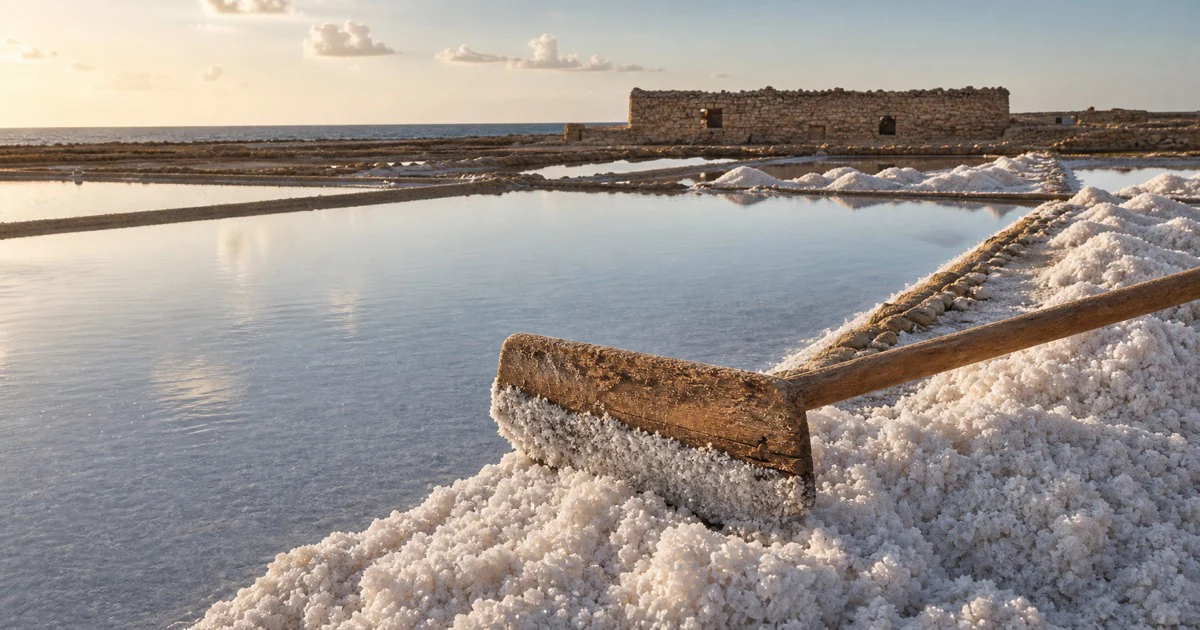
Salt is sodium chloride, a mineral that people encounter in sea water, brine springs, salt lakes, and underground beds of halite. It was never invented in one country. What changed history was the ability to find concentrated salt, separate it from water or rock, carry it, and control who could buy it. In a coastal landscape, evaporation can leave crystals behind. Inland, people can boil mineral-rich brine or mine ancient deposits left by vanished seas. [10]
That geography matters. A settlement beside a productive spring or salt pan had a resource that could season food, preserve a catch, support animals, and travel far beyond the place where it was made. A community without easy access had to trade, ration, or pay someone else for it. Salt therefore belongs to the history of geology as much as cuisine: it is a mineral whose uneven distribution made it a social and political problem.
Calling salt universally rare is too simple. Some regions had abundant sea water or brine; others had difficult terrain, distant deposits, or seasonal access. Its value came from the gap between everyday need and local availability. That gap is why the history of salt is really a history of extraction, preservation, transport, taxation, and power.
Where Did People First Make Salt?
Among the strongest early records comes from Poiana Slatinei-Lunca in north-eastern Romania. Archaeologists found evidence that Early Neolithic communities heated highly concentrated brine there between about 6050 and 5500 BCE. The result was crystallised salt that could be handled and moved, not merely salty water at a spring. The researchers describe it as the oldest known salt exploitation in Europe and probably the world, but the careful historical wording is “among the earliest well-dated evidence,” not an absolute origin story for all saltmaking. [1]
China has an important but different evidence trail. At Zhongba in the Three Gorges region, chemical and archaeological analysis shows that salt was the primary product during the first millennium BCE. That matters because it demonstrates a developed production system, not because it proves that China and Romania shared one single “first salt” date. Rowan Flad's later work follows Zhongba through changing techniques, scale, and social organization across millennia. [2][4]
The larger pattern is independent discovery. People who had sea water used sun and wind; people with springs used heat; people above salt beds quarried or mined. There was no lone inventor of salt, only recurring human solutions to the problem of turning a distributed mineral into a dependable food technology.
How Salt Preserved Food Before Refrigeration
Salt became historically powerful because food spoils. When enough salt is added to food or brine, it lowers water activity and makes it harder for many spoilage organisms and pathogens to grow. That is not a promise that every salted food is safe forever: concentration, temperature, acidity, time, and handling all still matter. But it explains why salt became one of the central preservation tools before refrigerators, freezers, and cold chains. [3]
Dry curing, brining, pickling, fermentation, and cheese-making use salt differently. A heavily salted fish-salted-cod product is designed for long storage; sauerkraut and kimchi use salt to draw water from vegetables and help create conditions for desired fermentation; miso relies on salt as part of a long, controlled microbial system. Salt does not do the same job in every food, but it repeatedly helps turn a short-lived harvest into something transportable or seasonal.
That preservation role changed diets and markets. Meat, fish, dairy, vegetables, and grain-based foods could move farther from the moment of harvest or slaughter. Ships, armies, pilgrimage routes, winter stores, and urban markets all depended on some version of this logic. Salt was flavor, but it was also time: a way to postpone decay.
How Salt Routes Built Trade Networks
Once salt could be stored as cakes, blocks, crystals, or packed cargo, it became trade goods rather than only local seasoning. Across the Sahara, caravan routes linked saltworks to markets for millet, dates, animals, textiles, and precious metals. UNESCO's documentation of the salt route through the Tenere and Bilma records a long tradition of salt extraction and caravan exchange, with journeys organized around both desert risk and the practical need to move a heavy, necessary commodity. [5]
Salt did not always travel because it was glamorous. It traveled because it was useful, storable, and demanded by households as well as by food producers. That gave it an unusual commercial profile: a relatively ordinary substance could finance roads, ports, caravans, storehouses, and merchant power. In different places, salt might be made from sea water, spring brine, lake deposits, or mines, then carried toward populations that lacked the same geography.
This is where salt connects to the history of bread, preserved fish, fermented foods, and spice trade. Trade networks rarely moved one thing alone. Salt traveled alongside other goods and made some of those goods easier to keep, sell, and eat. Mark Kurlansky's global history is useful background here, but the regional evidence matters more than a single sweeping “salt built civilization” slogan. [5][11]
Why States Taxed and Monopolized Salt
A state does not need a luxury product to tax it effectively. It needs a product people cannot easily avoid. Salt fit that logic: households needed it, food producers needed it, and the routes and depots through which it moved could be supervised. Chinese evidence shows how specialized salt production could become linked to changing social hierarchy and organized control long before modern nation-states. [4]
In France, the gabelle was not one neat nationwide tax with one fixed rate. It developed through changing taxes, sales monopolies, regions, exemptions, and rules. The French Ministry of Economy's historical archive notes that the Crown reserved a monopoly over salt sales in 1547, while different provinces faced sharply unequal conditions. Those differences encouraged smuggling, known as faux-saunage, and made salt a vivid symbol of fiscal unfairness. [6]
That detail matters because “salt tax” is not a metaphor. It was a system of prices, compulsory purchase rules, local privilege, enforcement, and punishment. Salt became politically charged not because everyone romanticized crystals, but because an essential household good could be turned into a recurring payment to the state.
Did Roman Soldiers Really Get Paid in Salt?
The short answer is: treat the story with caution. The neat claim that Roman soldiers were literally paid in bags of salt is repeated so often that it sounds ancient, but the word link alone does not prove the practice. Latin salarium is connected to sal, meaning salt, yet the historical path from that term to the modern word “salary” is more complicated than the familiar anecdote suggests.
The Oxford Classical Dictionary records salarium as a term for payment, including the pay of a proconsul, while not presenting a simple documentary equation between ordinary soldier wages and salt. Salt certainly mattered to Roman provisioning, trade, and state revenue. That makes the myth feel plausible. But plausibility is not the same as evidence, and a food-history page should not use it as a clean origin fact. [9]
The better story is already rich enough: Roman worlds used coin, rations, supply systems, roads, ports, and taxes. Salt belonged inside that logistical landscape. It does not need a false salary legend to be historically important.
Why Gandhi Chose Salt
Gandhi chose salt in 1930 because it connected a legal restriction to everyday life. On March 2 he wrote to Viceroy Lord Irwin explaining why he intended to break the salt law. On March 12 he set out from Sabarmati Ashram toward Dandi, turning the British monopoly and tax into a public act of civil disobedience. [7]
The Salt March worked symbolically because salt crossed class and regional lines. It was made, bought, cooked with, and needed in ordinary households. Yet the history should not be reduced to a single cinematic march. Miles Taylor's research places Gandhi's choice inside the longer political economy of British Indian salt control, including the nineteenth-century consolidation of the monopoly and the fiscal systems surrounding it. [8]
That is why the Salt March remains so powerful in food history. It shows how an ingredient can become a language of political legitimacy. The issue was not whether salt tasted good. It was who had the right to make it, move it, tax it, and live without punishment for touching it.
How Salt Became an Everyday Global Commodity
Modern people can mistake cheap table salt for evidence that salt no longer matters. In reality, the mineral moved from a household preservative into a vast industrial system. The U.S. Geological Survey lists uses that include de-icing, chlor-alkali production, water treatment, agriculture, food processing, and consumer manufacturing. Much of the world's salt now enters industrial chains rather than a kitchen shaker. [10]
Food still gives salt cultural meaning. Table salt, kosher salt, sea salt, curing salt, brining salt, fleur de sel, smoked salt, black salt, and pink salt signal differences in grain, source, process, texture, and culinary ritual. Some are technically useful in particular methods; others are status markers or flavor preferences. The history of salt helps explain why an apparently simple white crystal can still carry arguments about authenticity, place, craft, and price.
Salt therefore survives two opposite stories at once. It is an everyday commodity produced at massive scale, and it is a historical technology that made foods last, markets connect, and states powerful. That double life is the real history behind the pinch on the table.
Historical Timeline
Early Neolithic communities at Poiana Slatinei in present-day Romania boil concentrated brine to make salt.
Archaeological and chemical evidence identifies salt as the primary product at Zhongba in the Three Gorges region of China.
Caravan networks move salt across the Sahara, linking saltworks, grain, dates, and long-distance exchange.
The French crown reserves a monopoly over salt sales through the gabelle system, intensifying regional inequality and smuggling.
The French Constituent Assembly abolishes the gabelle; later regimes restore salt duties before the tax finally disappears in 1945.
Gandhi begins the Salt March from Sabarmati Ashram on March 12, turning the salt law into a focus of civil disobedience.
Evidence Explorer
Review the Source Trail
Inspect the article sources, scoped review credits, and copyable citation details without leaving the page.
Reviewed for Stated Scope
Sources Listed
Comments
Community comments are coming soon. Check back later to join the discussion!