💡 Key Takeaways
- The chicken (Gallus gallus domesticus) descends primarily from the Red Junglefowl of Southeast Asia, initially domesticated for cockfighting and religious rituals rather than food.
- There are an estimated 33 billion chickens on Earth today — roughly four chickens for every human — making them the most abundant bird species on the planet by orders of magnitude.
- The discovery of vitamin D in 1922 revolutionized chicken farming by allowing birds to be raised indoors year-round without developing rickets, paving the way for modern factory farming.
When was the chicken "invented"?
When was the chicken "invented"? While chickens were not invented, the modern chicken (Gallus gallus domesticus) was domesticated from the red junglefowl (Gallus gallus) in Southeast Asia and Southern China around 6,000 BCE [1]. Domesticating the shy, pheasant-like bird represented a major milestone in agricultural history. Genetic and archaeological evidence suggests domestication occurred in regions spanning modern-day Thailand, Vietnam, and southern China between 6,000 and 8,000 years ago. Crucially, early humans likely did not domesticate the chicken for its meat or its eggs. Wild junglefowl are small, stringy, and lay only a few eggs a year during the spring breeding season [1].
Instead, the primary motive for domestication was almost certainly cultural and religious. The roosters were prized for cockfighting—a blood sport that served as a proxy for human conflict and a method of gambling—and the birds were widely used in augury (divination) and religious sacrifices. As chickens spread westward along ancient trade routes to the Indus Valley and eventually to the Mediterranean, they retained this sacred aura long before they became a staple food [2].
How did chicken evolve over time?
Chickens reached Egypt by around 1500 BCE, where a major technological breakthrough occurred: the invention of the artificial incubator. Egyptians built massive mud-brick ovens heated by camel dung, capable of hatching thousands of chicks at once. This broke the biological bottleneck of waiting for hens to become broody, transforming the chicken from a rare exotic bird into an agricultural commodity [1].
The Romans enthusiastically adopted the chicken, breeding specialized birds for meat and eggs, and incorporating them deeply into their cuisine and military rituals. However, after the fall of Rome, the organized breeding of large chickens collapsed in Europe. For centuries, medieval chickens reverted to being small, tough, free-ranging scavengers that scratched out a living in peasant barnyards. They were valued primarily for their eggs; eating a chicken was a rare luxury, usually reserved for when a bird was too old to lay [3].
In the mid-19th century, a bizarre phenomenon known as "Hen Fever" swept the United States and Britain. Queen Victoria was gifted exotic, massive Cochin chickens from China, sparking a speculative bubble where wealthy hobbyists paid exorbitant prices for ornamental breeds. While the bubble burst, this mania cross-bred massive Asian meat birds with prolific European egg-layers, laying the genetic groundwork for the modern poultry industry [2].
Why is chicken culturally important?
The chicken's incredible adaptability has made it the most universal meat on Earth. Unlike pork (forbidden in Islam and Judaism) or beef (forbidden in Hinduism), the chicken is subject to almost no major religious taboos. It is the blank canvas of global cuisine, capable of absorbing the distinct flavor profiles of almost every culinary tradition. From French Coq au Vin to Indian Murgh Makhani (Butter Chicken), Jamaican Jerk Chicken to Hainanese Chicken Rice, no other protein is so universally embraced [1].
Beyond the plate, the chicken permeates human language and symbolism. We speak of "pecking orders," being "cooped up," "hatching a plan," or acting "chicken" (cowardly). The rooster remains a universal symbol of dawn, vigilance, and rural life [2].
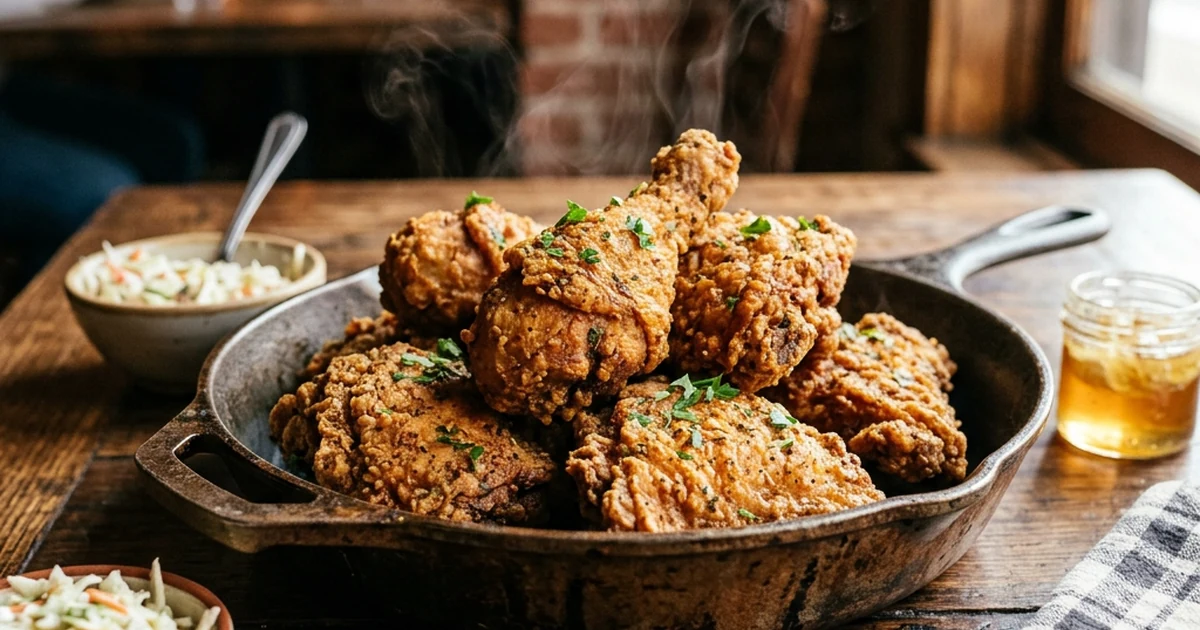
The rise of fried chicken is particularly significant. Originally an expensive dish reserved for special occasions in the American South (fusing Scottish frying techniques with West African seasoning traditions), it was commercialized in the 20th century. Today, fast-food fried chicken is a global juggernaut, adapting to local tastes worldwide—most notably in South Korea, where "chimaek" (fried chicken and beer) is a national obsession, and in Japan, where eating KFC has become a deeply ingrained Christmas tradition [3].
Modern Renaissance
The transformation of the chicken in the 20th century is one of the most dramatic stories in agricultural history. In 1923, Celia Steele of Delaware accidentally ordered 500 chicks instead of 50. Instead of returning them, she raised them in a shed for meat, effectively inventing the modern commercial broiler industry. The discovery of Vitamin D allowed chickens to be raised indoors year-round without sunlight, and the widespread use of antibiotics enabled farmers to keep thousands of birds in confined spaces without disease outbreaks [1].
In 1948, an American supermarket chain sponsored the "Chicken of Tomorrow" contest to breed a bird with a massive breast and rapid growth rate. The winning genetics formed the basis of the modern broiler. Today, a commercial broiler reaches its market weight of over 6 pounds in just 47 days—growing so fast that its skeleton and organs often struggle to support its muscle mass. This incredible, brutal efficiency has made chicken the cheapest and most consumed meat globally, surpassing pork [2].
Today, there are an estimated 33 billion chickens on Earth. The environmental footprint of chicken is lower than beef or pork, but the industry faces massive ethical scrutiny regarding the welfare of birds raised in massive, windowless sheds. As a result, a premium market for pasture-raised, slower-growing heritage breeds (like the French Poulet de Bresse) has emerged, appealing to consumers willing to pay more for animal welfare and the complex, deeper flavor that the chicken lost in its race to become the world's cheapest protein [3].
In the news
Recent 2026 food-culture notes that reference this article.
Historical Timeline
Red Junglefowl domesticated in Southeast Asia, likely for cockfighting
Chickens reach Egypt, where artificial incubation is invented
Celia Steele raises 500 chicks for meat in Delaware, founding the modern broiler industry
The "Chicken of Tomorrow" contest in the US creates the genetic template for the modern broiler
Chicken officially surpasses pork as the most consumed meat in the world
Evidence Explorer
Review the Source Trail
Inspect the article sources, scoped review credits, and copyable citation details without leaving the page.
Reviewed for Stated Scope
Sources Listed
Comments
Community comments are coming soon. Check back later to join the discussion!