💡 Key Takeaways
- Onion (Allium cepa) has no surviving wild ancestor — it is known only in cultivation, suggesting domestication so ancient (possibly 5,000–7,000 years ago in Central Asia) that the wild progenitor went extinct or was absorbed into cultivated stock.
- Ancient Egyptians revered the onion as a symbol of eternity because of its concentric layers: onions were placed in pharaohs' eye sockets during mummification, and workers on the Great Pyramid received onion rations.
- India, the world's second-largest onion producer after China, has repeatedly imposed export bans when domestic onion prices spike — a politically explosive move that contributed to the fall of the Delhi state government in 1998.
Where did onion originate?
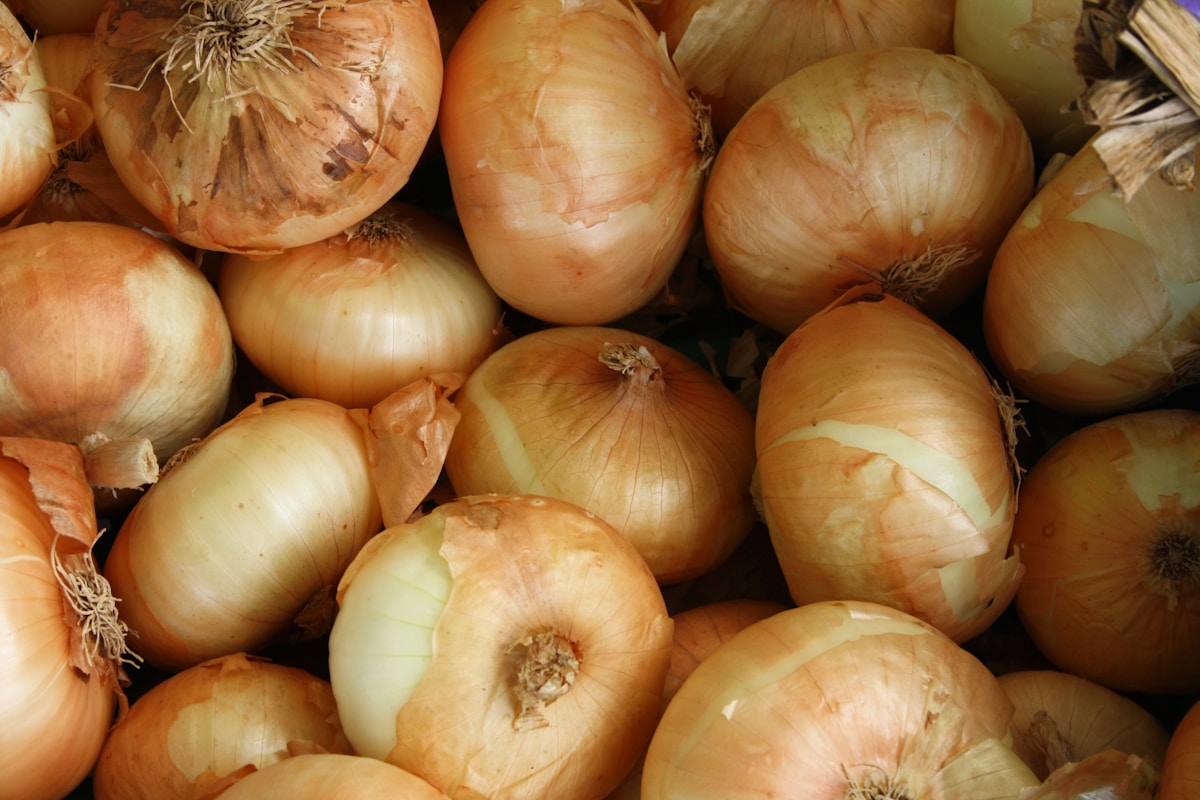
The onion (Allium cepa) occupies a unique position in plant biology: it has no known surviving wild ancestor. Unlike garlic, wheat, or maize — whose wild relatives can still be found growing naturally — the onion exists exclusively in cultivation, a fact that has complicated efforts to pinpoint its exact origin. Botanists believe domestication occurred somewhere in the highlands of Central Asia (modern Uzbekistan, Tajikistan, or Afghanistan) between 5,000 and 7,000 years ago, where related wild Allium species still grow. The wild progenitor either went extinct through habitat loss or was so thoroughly absorbed into cultivated populations that it can no longer be distinguished [1].
What we know with certainty is that onions were well established in the ancient Near East by the Bronze Age. Sumerian cuneiform tablets from around 2500 BCE list onions among staple provisions, and the ancient Egyptian relationship with onions was especially intense. Egyptian tomb paintings show onions heaped on offering tables, and physical onions have been recovered from burial sites across three millennia — including traces found in the wrappings and eye sockets of pharaonic mummies. Egyptians apparently revered the onion's concentric rings as a symbol of eternity and the cosmos, and the Greek historian Herodotus recorded an inscription claiming that onion purchases for pyramid workers totalled 1,600 talents of silver [2].
How did onion evolve over time?
Greeks and Romans cultivated onions extensively. Pliny the Elder described multiple varieties in his Natural History, and Roman legionaries carried onions as standard rations — believing they built strength and courage. The gladiator diet at Pompeii, reconstructed from bone isotope analysis, shows heavy reliance on allium-rich foods. Roman colonists spread onion cultivation throughout their empire, from Britannia to North Africa [3].
Medieval Europe made the onion a universal staple. Charlemagne's Capitulare de Villis (c. 800 CE) mandated onion cultivation on every crown estate. In England, onions served as currency: 14th-century manorial records document rent payments in onions, and they were common wedding gifts symbolising domestic prosperity. French onion soup (soupe à l'oignon) became a Parisian tradition attributed to Louis XV, who reportedly made it himself from onions, butter, and champagne after a late-night hunting trip [1].
European colonists brought onions to the Americas almost immediately. The Pilgrims planted them in Massachusetts in 1648, and by the 19th century, the Vidalia region of Georgia (where low-sulfur soil produces exceptionally sweet onions) and Walla Walla, Washington, had developed signature varieties. Spanish colonists introduced onions to Latin America, where they became foundational to sofrito and sautéed bases across Central and South American cuisines [2].
Why is onion culturally important?
The onion's culinary universality is unmatched. It appears in the foundational flavour base of virtually every major cuisine: French mirepoix (onion, carrot, celery), Italian soffritto, Cajun "holy trinity" (onion, celery, bell pepper), Indian tadka, Chinese aromatics, and West African sofrito. No other single vegetable plays such a structurally identical role across so many unrelated culinary traditions [3].
The chemistry behind onion tears was fully elucidated only in 2002, when Japanese researcher Shinsuke Imai identified the lachrymatory factor synthase enzyme that produces syn-propanethial-S-oxide — the volatile compound that makes eyes water. This was decades after humanity's first domestication and 4,500 years after Egyptian priests were already breeding milder onion varieties for temple offerings [2].
In Indian culture, the onion occupies a paradoxical position: indispensable in everyday cooking yet forbidden by Jain monks and some Brahmin traditions as a rajasic (stimulating) food. The Jain prohibition extends to garlic and root vegetables believed to harbour microscopic organisms. Yet for most of India's 1.4 billion people, the onion is so essential that price spikes trigger genuine political crises — onion inflation is tracked as a leading indicator of ruling party electoral vulnerability [1].
Modern Renaissance
Global onion production exceeds 105 million tonnes annually, making it the second most cultivated vegetable after tomatoes. China leads production, followed by India (roughly 25 million tonnes), the United States, Egypt, and Turkey. The sheer volume is staggering: humanity grows more onions by weight than all citrus fruits combined [1].
India's onion market is a case study in how a humble vegetable becomes a political weapon. In September 2019, monsoon flooding destroyed crops in Maharashtra, India's largest onion-producing state. Prices surged 400% within weeks. The government banned exports, deployed emergency reserves, and faced parliamentary censure. This was not unprecedented: onion price crises in 1980 and 1998 are credited with contributing to the defeat of ruling governments. No other food commodity in any democracy has such a direct, documented connection to electoral outcomes [3].
Speciality onion markets continue to expand. Georgia's Vidalia onions carry federal marketing protection (only onions grown in a 20-county region can use the name). Tropea red onions from Calabria, Italy, hold EU PGI (Protected Geographical Indication) status. Japanese research teams have developed "tearless" onion varieties by silencing the lachrymatory factor synthase gene — a breakthrough announced by House Foods Group in 2015 that commercial growers are slowly adopting. From pharaonic eye sockets to CRISPR gene editing labs, the onion remains humanity's most essential and most taken-for-granted vegetable [2].
Historical Timeline
Onion cultivated in Central Asia; no wild ancestor survives today
Egyptians place onions in pharaohs' tombs and use them as currency for pyramid labourers
Onions become a staple across medieval Europe, eaten raw, cooked, and pickled
Pilgrim records list onions among the first European crops planted in Massachusetts
India's onion crisis: prices surge 400%, triggering export bans and political upheaval
Evidence Explorer
Review the Source Trail
Inspect the article sources, scoped review credits, and copyable citation details without leaving the page.
Sources Listed
Comments
Community comments are coming soon. Check back later to join the discussion!