💡 Key Takeaways
- Garlic (Allium sativum) descended from wild Allium longicuspis in the Tien Shan mountains of Central Asia — and, like saffron crocus, it is a sterile plant that cannot reproduce sexually, relying entirely on human clove-planting.
- The Ebers Papyrus (c. 1550 BCE) lists garlic in 22 separate Egyptian remedies, and Herodotus recorded that 1,600 silver talents' worth of garlic, onions, and radishes were purchased to feed the workers who built the Great Pyramid of Giza.
- China produces roughly 80% of the world's garlic — over 24 million tonnes annually — and dominates global trade to such a degree that the EU imposed anti-dumping duties on Chinese garlic imports in 2001.
Where did garlic originate?
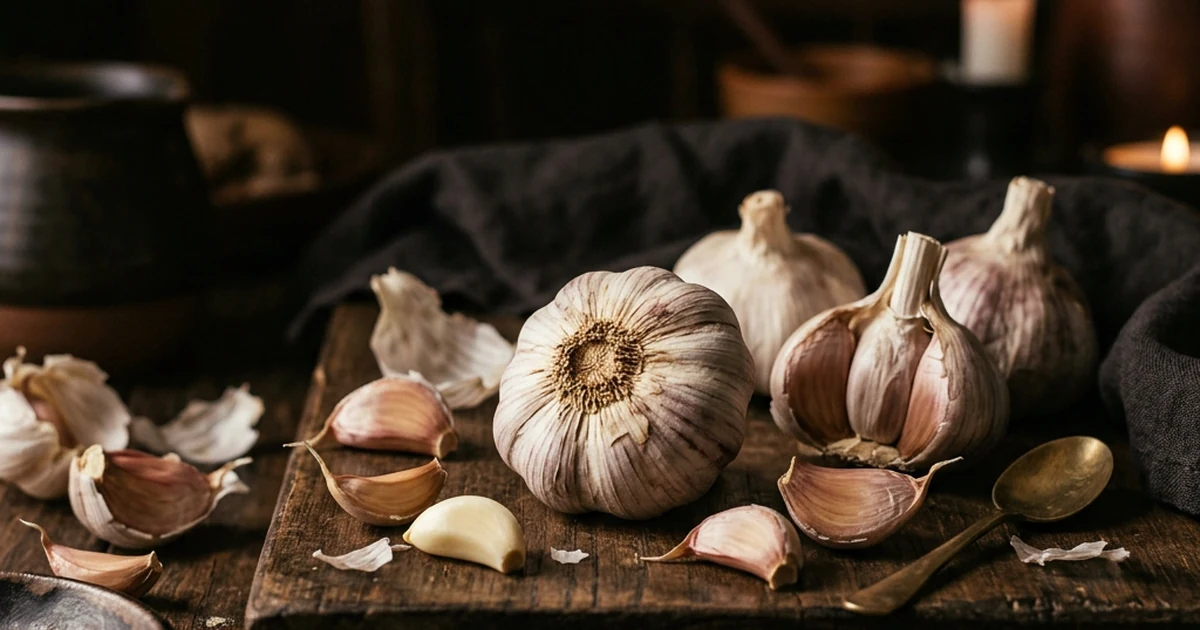
Garlic (Allium sativum) is a sterile bulb plant that cannot reproduce sexually — it sets no viable seed and exists only because humans have propagated it by planting individual cloves for millennia. Genetic analysis published by Hirschegger et al. in Molecular Phylogenetics and Evolution (2010) traced cultivated garlic's closest wild relative to Allium longicuspis, a species native to the Tien Shan mountains spanning modern Kazakhstan, Kyrgyzstan, and western China. From this highland origin, garlic spread down ancient trade corridors into Mesopotamia and the Indus Valley by at least 3000 BCE [1].
Ancient civilisations treated garlic with a reverence unusual for a common seasoning. In Egypt, garlic appears in 22 of the roughly 800 remedies in the Ebers Papyrus (c. 1550 BCE), prescribed for infections, intestinal parasites, and heart complaints. Herodotus (c. 450 BCE) famously recorded an inscription on the Great Pyramid of Giza stating that 1,600 silver talents were spent on garlic, onions, and radishes for the labourers — a sum roughly equivalent to constructing a fleet of warships. Whether or not this specific figure is reliable, archaeological evidence confirms that garlic bulbs and garlic-shaped clay models were placed in Egyptian tombs, including the burial chamber of Tutankhamun [2].
How did garlic evolve over time?
Greek and Roman cultures placed garlic at the intersection of athletics, warfare, and class anxiety. Greek Olympians consumed garlic before competition, making it arguably history's first performance-enhancing substance. Roman legionaries ate garlic rations for stamina, and Pliny the Elder's Natural History describes over 60 garlic-based remedies. Yet Roman elites associated garlic with the lower classes: the poet Horace called garlic "more poisonous than hemlock" after a particularly pungent meal, establishing a class-based prejudice that would persist in European aristocratic dining for centuries [3].
Medieval Europe held garlic in contradictory regard. Folk tradition considered it a ward against plague, evil spirits, and vampires — beliefs rooted in its genuine antiseptic properties. Yet monastic rules sometimes banned it for inciting "lustful desires," and upper-class English and French cuisines marginalised garlic as peasant food until the 20th century [1]. In North Africa, garlic remained a highly celebrated foundation, blended with oil and spices to yield powerful condiments like Tunisian harissa.
In Asia, garlic followed entirely different cultural trajectories. Chinese cuisine has used garlic for over 4,000 years, and Chinese production now dominates global supply. Korean cuisine made garlic foundational — the origin myth of Korea (Dangun) involves a bear eating 20 cloves of garlic and mugwort for 100 days to become human. Indian Ayurvedic medicine classified garlic as rajasic (stimulating), discouraging its use among Brahmin priests but endorsing it for warriors and labourers [2].
Why is garlic culturally important?
Few foods carry more superstitious weight than garlic. The vampire-garlic connection, popularised by Bram Stoker's Dracula (1897), draws on centuries of Eastern European folk medicine: Romanian and Slavic traditions hung garlic braids on doorframes, rubbed garlic on windowsills, and placed cloves in the mouths of the dead to prevent them from rising. These beliefs likely originated from garlic's genuine bactericidal properties — in eras when infection and decomposition were poorly understood, a substance that slowed putrefaction seemed genuinely magical [1].
Culinarily, garlic is perhaps the most universally used seasoning on Earth. French cuisine builds on soffritto (garlic, onion, and celery); Spanish cooking starts with garlic sautéed in olive oil; Chinese stir-fry begins with garlic, ginger, and scallion; Korean food deploys garlic in virtually every banchan (side dish). Mediterranean, Middle Eastern, Latin American, and Southeast Asian cuisines all treat garlic as a non-negotiable foundational ingredient [3].
The science behind garlic's flavour is itself remarkable. Intact garlic has almost no smell. Only when cells are ruptured — by cutting, crushing, or chewing — does the enzyme alliinase convert the odourless amino acid alliin into allicin, the volatile thiosulfinate responsible for garlic's pungent bite. This chemical reaction occurs in under 10 seconds and is a defence mechanism against soil pathogens — repurposed by humans as one of the most distinctive flavours in world cuisine [1].
Modern Renaissance
China utterly dominates modern garlic production, growing over 24 million tonnes annually — roughly 80% of the global total. Shandong province alone produces more garlic than every other country combined. This dominance has geopolitical consequences: the European Union imposed anti-dumping duties on Chinese garlic imports in 2001, and the "garlic price crisis" of 2009–2010 (when Chinese speculators drove prices up 40-fold) made international headlines [3].
Outside China, significant producers include India, South Korea, Egypt, and the United States. California's Gilroy region, self-proclaimed "Garlic Capital of the World," has hosted an annual Garlic Festival since 1979 that draws over 100,000 visitors and features garlic ice cream, garlic fudge, and cooking competitions. In France, the Arleux garlic festival in northern France and the smoked garlic of the Pays de la Loire carry Protected Geographical Indication status [2].
Garlic's medicinal reputation has attracted serious scientific scrutiny. A 2016 Cochrane review found that garlic supplementation may modestly reduce blood pressure. Allicin's demonstrated antibacterial and antifungal properties have led to its investigation as a natural food preservative. The aged garlic extract (AGE) supplement industry is valued at over $300 million annually. Yet garlic's greatest contribution remains culinary: it is, by any measure, the most indispensable flavouring in the global kitchen — a claim no other single ingredient can credibly make [1].
In the news
Recent 2026 food-culture notes that reference this article.
Historical Timeline
Wild garlic (Allium longicuspis) cultivated in the Tien Shan mountains of Central Asia
Ebers Papyrus lists garlic in 22 Egyptian medical remedies
Greek Olympians consume garlic before competing, making it history's first performance-enhancing food
Louis Pasteur demonstrates garlic's antibacterial properties in laboratory tests
Gilroy, California, hosts its first annual Garlic Festival, now drawing 100,000+ visitors
Evidence Explorer
Review the Source Trail
Inspect the article sources, scoped review credits, and copyable citation details without leaving the page.
Reviewed for Stated Scope
Sources Listed
Comments
Community comments are coming soon. Check back later to join the discussion!