💡 Key Takeaways
- Archaeological evidence from South Africa shows that early humans (and Neanderthals in Europe) relied heavily on oysters for crucial omega-3 fatty acids, which aided brain development.
- The ancient Romans were the first to develop sophisticated oyster aquaculture, inventing techniques to catch free-swimming oyster larvae on tiles to seed artificial beds.
- In the 19th century, New York City was the oyster capital of the world; oysters were so abundant and cheap they were considered a staple food for the working class, not a luxury.
Where did oysters originate?
For early hominids living along coastlines, the oyster was the ultimate fast food: protein-dense, rich in brain-building omega-3 fatty acids, and requiring no weapons to catch—just a rock to smash the shell. Anthropologists have found massive "middens" (ancient refuse heaps) composed of millions of oyster shells worldwide, from the coasts of South Africa (dating back 164,000 years) to the shores of Australia, Japan, and the Americas. For indigenous peoples, from the Lenape in modern-day Manhattan to the Aboriginal Australians, oysters were a foundational, reliable caloric base that sustained populations through harsh winters when terrestrial game was scarce [1].
The transition from simply gathering wild oysters to actively cultivating them began with the Romans. Around the 1st century BCE, a Roman engineer and entrepreneur named Sergius Orata invented the first known system of aquaculture in the Lucrine Lake near Naples. He figured out how to catch free-swimming oyster larvae (spat) by lowering bundles of twigs or tiles into the water, then moving the seeded tiles to protected artificial beds to grow. This allowed the Romans to mass-produce oysters, which they shipped alive in seawater-filled amphorae to the furthest corners of their empire [2].
How did oysters evolve over time?
After the fall of Rome, oyster consumption in Europe remained localized to coastal communities. However, as urbanization accelerated in the 18th and 19th centuries, oysters became the ultimate urban street food in cities like London and Paris. Charles Dickens frequently referenced oysters in his writing, noting that "poverty and oysters always seem to go together." They were cheap, abundant, and filling, often baked into pies with cheap cuts of meat to stretch the protein [1].
But nowhere was the oyster more dominant than in the United States, specifically New York City. When Henry Hudson arrived in 1609, the harbor contained an estimated 350 square miles of oyster reefs—nearly half the world's population of oysters. By the mid-19th century, New York was the global capital of oyster consumption. "Oyster cellars," street carts, and saloons sold them for pennies. Working-class New Yorkers ate them raw, fried, in stews, and pickled. The shells were so voluminous they were ground up to pave the city's streets (such as Pearl Street) and burned to make lime for the masonry of iconic buildings like Trinity Church [2].
Why is oysters culturally important?
The cultural status of the oyster is deeply paradoxical. Throughout the 19th century, it was the food of the everyman—the hamburger of its day. However, as the 20th century dawned, a combination of explosive population growth, raw sewage dumped directly into harbors, and relentless over-harvesting led to the total collapse of the great urban oyster beds in New York, London, and elsewhere. Typhoid outbreaks linked to raw oysters caused public panics. As supply crashed, the oyster rapidly transitioned from a cheap staple to an expensive, rare luxury item, a status it largely retains today [1].
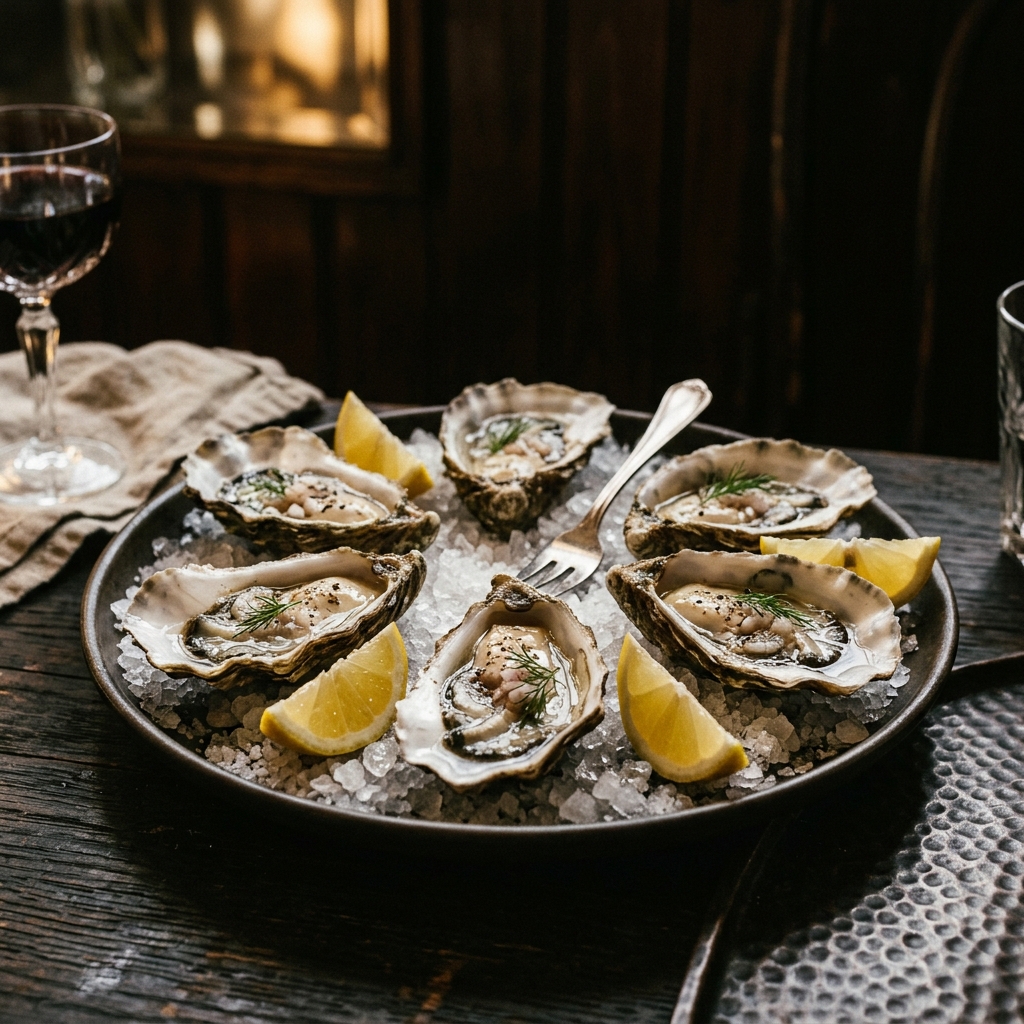
Despite this shift, the ritual of eating raw oysters remains one of the most primal and visceral culinary experiences in Western gastronomy. The writer M.F.K. Fisher famously described eating an oyster as "a mild, fleeting, but sharp sensation of the sea." Oysters are profoundly defined by their "merroir" (the marine equivalent of terroir). Because they filter gallons of water daily, their flavor, salinity, and texture are exact reflections of the specific bay, inlet, or estuary where they grew—making a Kumamoto from Washington taste entirely different from a Blue Point from New York [2].
Culturally, oysters have long been associated with romance and virility. While their reputation as an aphrodisiac is largely anecdotal, they are exceptionally high in zinc and rare amino acids that trigger the production of sex hormones, lending a shred of scientific credibility to Casanova's famous dietary habit [3].
Modern Renaissance
The 21st century has brought a remarkable oyster renaissance, driven not by wild harvesting, but by highly sustainable aquaculture. Unlike farming carnivorous fish (like salmon), farming oysters requires no feed; they eat naturally occurring phytoplankton, actively cleaning the water in the process. Environmentalists and chefs alike champion oyster farming as one of the few forms of agriculture that leaves the environment healthier than before [1].
Cities like New York are now engaging in massive restoration projects (such as the Billion Oyster Project) to rebuild the ancient reefs. The goal is not primarily to harvest them for food, but to utilize the oysters' incredible filtering power to clean polluted harbors and create natural breakwaters to protect against storm surges caused by climate change [2].
Gastronomically, we are in a golden age of the boutique oyster. Farmers utilize specialized tumbling and suspension techniques to cultivate oysters with deep cups and specific flavor profiles, catering to a booming culture of raw bars. The oyster has survived near-extinction by human hands to become our greatest ally in restoring the coastal ecosystems we once destroyed [3].
Historical Timeline
Evidence of early human oyster consumption found in Pinnacle Point, South Africa
Roman engineer Sergius Orata invents the first artificial oyster beds near Naples
Henry Hudson discovers New York Harbor, noting oyster beds of unimaginable scale
New York City consumes an estimated 12 million oysters a day
Pollution and over-harvesting destroy the great oyster beds of New York and London
Evidence Explorer
Review the Source Trail
Inspect the article sources, scoped review credits, and copyable citation details without leaving the page.
Sources Listed
Comments
Community comments are coming soon. Check back later to join the discussion!