
U.S. purchase guide

Which Coconut Milk Should You Buy? Full-Fat vs Light vs Carton

Three U.S.-available coconut milks compared by coconut extract percentage, gum stabilizers, can vs carton packaging, unit price, and cooking fit.
Published Updated Market: United StatesBy
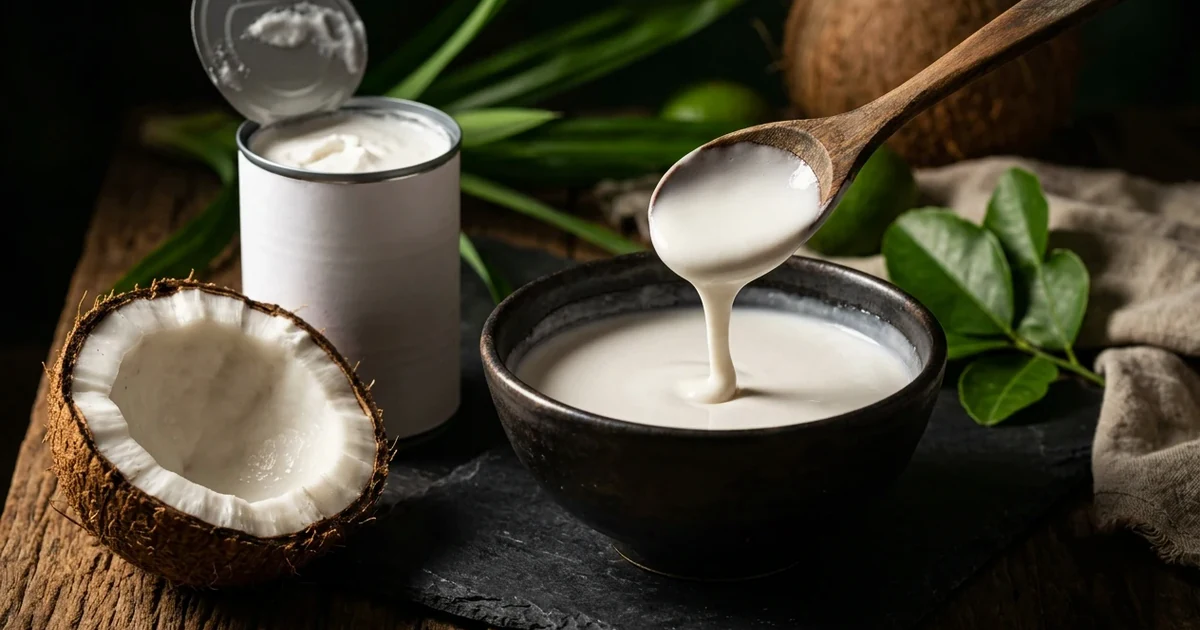
An opened unlabelled tin of full-fat coconut milk showing natural thick cream separation beside a cracked fresh coconut and ceramic bowl
Culinary coconut milk in cans ranges from 100% pure two-ingredient extracts to gum-stabilized emulsions and diluted carton beverages. Image: The Foods That Shaped Us Research Desk. Image terms. Request permission.

Purchase verdict

For authentic Thai curries, laksa, and simmered sauces that require natural fat separation to fry curry paste in coconut oil, Aroy-D 100% Pure Coconut Milk (60% coconut extract, no added gums or preservatives) is the cleanest documented fit. Native Forest Organic Classic Coconut Milk provides a USDA-certified organic canned baseline with organic guar gum for emulsion stability in baking and desserts. Chaokoh offers an everyday supermarket standard with added stabilizers for a uniform consistency in soups. These are extraction ratio and stabilizer distinctions, not a blind taste ranking.

Track this category through time

Quick choices

Observed prices are U.S. snapshots from August 30, 2026. Seller links are direct and non-affiliate.

Product choices, documented use, observed U.S. price, package size, unit price, and seller
ProductDocumented fitObserved priceSeller
Aroy-D (Thai Agri Foods) 100% Pure Coconut MilkPure culinary coconut milk without gums; 13.5 fl oz (400 ml) canFor home cooks making authentic Thai curries, soups, and Southeast Asian desserts requiring pure coconut without emulsifiers or gums.$3.2913.5 fl oz$0.24 per fl ozAvailable when checkedCheck Thai Agri FoodsVerified 2026-08-30
Native Forest (Edward & Sons) Organic Classic Coconut MilkCertified organic full-fat coconut milk; 13.5 fl oz (400 ml) canFor bakers, ice cream makers, and organic shoppers seeking a certified organic, BPA-free lined can with consistent creamy texture.$4.1913.5 fl oz$0.31 per fl ozAvailable when checkedCheck Edward & SonsVerified 2026-08-30
Chaokoh (Theppadungporn Coconut Co.) Coconut MilkCommercial full-fat culinary coconut milk; 13.5 fl oz (400 ml) canFor everyday home cooking and soups seeking a widely distributed, cost-effective canned coconut milk across major supermarkets.$2.7913.5 fl oz$0.21 per fl ozAvailable when checkedCheck Theppadungporn Coconut Co.Verified 2026-08-30

Where to buy in the U.S.

These direct, non-affiliate seller pages were checked on August 30, 2026. Stock, shipping, taxes, and checkout prices can vary by location and date.

How products were selected

  • We selected products with a manufacturer-controlled U.S. product page, a readable ingredient list, a stated package size, and a price observed on August 30, 2026.
  • The comparison separates documented coconut extract percentages, stabilizer ingredients, and package types from sensory judgments. The Research Desk has not completed a side-by-side taste test of these milks.
  • Unit prices use the observed single-can price before shipping, tax, subscriptions, bundles, or checkout discounts.

Product evidence

documented only

Aroy-D (Thai Agri Foods) 100% Pure Coconut Milk

Pure culinary coconut milk without gums; 13.5 fl oz (400 ml) can

Check seller

For this use: For home cooks making authentic Thai curries, soups, and Southeast Asian desserts requiring pure coconut without emulsifiers or gums.

Ingredients documented
Coconut extract (60%), water (40%).
Stated origin / claims
Grown and processed in Thailand.; No preservatives claim; No guar gum claim; Non-GMO claim
Suitable uses
Thai green, red, and massaman curries; Tom kha gai soup; Mango sticky rice and coconut puddings
Allergens to check
Check the current package and facility statement.

Documented advantages

  • Pure 60% coconut extract and water formula with zero guar gum or thickeners
  • Allows natural separation of coconut cream for traditional paste frying
  • Smooth, clean mouthfeel without gelatinous texture

Limitations

  • Separates into solid cream and liquid water at temperatures below 75°F (requires shaking or heating)
  • Can dent easily during shipping
  • Short refrigerated shelf life once opened (2-3 days) due to lack of preservatives

documented only

Native Forest (Edward & Sons) Organic Classic Coconut Milk

Certified organic full-fat coconut milk; 13.5 fl oz (400 ml) can

Check seller

For this use: For bakers, ice cream makers, and organic shoppers seeking a certified organic, BPA-free lined can with consistent creamy texture.

Ingredients documented
Organic coconut, filtered water, organic guar gum.
Stated origin / claims
Sourced from certified organic coconut orchards in Sri Lanka and Thailand.; USDA Organic; QAI Certified Organic; Non-GMO Project Verified; Kosher Certified; BPA-NI Can Lining
Suitable uses
Vegan baking and dairy-free frostings; Coconut ice cream and custard bases; Creamy vegetable curries and grain porridge
Allergens to check
Check the current package and facility statement.

Documented advantages

  • USDA Certified Organic and Non-GMO Project Verified
  • BPA Non-Intent (BPA-NI) can lining verified by maker
  • Organic guar gum maintains smooth emulsion without clumping in baked goods

Limitations

  • Guar gum prevents traditional fat separation needed for "cracking" coconut milk in Thai curries
  • Higher unit price per ounce than conventional imports
  • Can impart a slightly heavier, thicker mouthfeel in delicate broths

documented only

Chaokoh (Theppadungporn Coconut Co.) Coconut Milk

Commercial full-fat culinary coconut milk; 13.5 fl oz (400 ml) can

Check seller

For this use: For everyday home cooking and soups seeking a widely distributed, cost-effective canned coconut milk across major supermarkets.

Ingredients documented
Coconut extract (55%), water, citric acid (as antioxidant), sodium metabisulfite (as preservative).
Stated origin / claims
Manufactured in Bangkok, Thailand.; HACCP Certified; ISO 9001 Certified; Halal Certified
Suitable uses
Quick weeknight curries and coconut rice; Marinades for chicken satay and grilled meats; Blended tropical smoothies and cocktails
Allergens to check
Check the current package and facility statement.

Documented advantages

  • Lowest unit price per ounce in this comparison
  • Widely available in both Asian specialty grocers and conventional U.S. supermarkets
  • Homogenized consistency disperses quickly into hot soups

Limitations

  • Contains sodium metabisulfite preservative (must be avoided by individuals with sulfite sensitivities)
  • Lower coconut extract percentage (55%) than Aroy-D
  • Slightly processed aftertaste compared to 100% pure unsweetened milk

What to check on the label

  • Distinguish canned culinary coconut milk from refrigerated carton "coconut beverage". Culinary cans contain 17% to 24% fat for cooking; carton drinks are diluted to 2% fat with added water, sugars, and calcium for cereal or drinking.
  • Check coconut extract percentage: Premium full-fat culinary coconut milk contains 55% to 70% coconut extract. "Light" coconut milk contains only 20% to 30% extract, with water making up the remainder.
  • Look for stabilizer additives: Cans with "guar gum" or "carboxymethylcellulose" (CMC) will not separate. Cans without gums naturally separate into a thick solid cream layer on top and thin liquid below, which is required for traditional Thai curry paste frying.
  • Check for sulfites: Some commercial brands add sodium metabisulfite or citric acid to prevent graying and extend shelf life; clean-label brands use only coconut and water.

Full-fat cans vs light cans vs refrigerated cartons: What the fat percentages mean

The term "coconut milk" spans three completely different grocery products with distinct culinary functions [4]. Authentic culinary coconut milk in metal cans or aseptic boxes is produced by grating the mature endosperm (meat) of Cocos nucifera and pressing it with hot water, yielding a rich liquid containing 17% to 24% coconut fat and 55% to 70% coconut extract [1][4]. "Light" coconut milk is simply standard coconut milk diluted with additional water to reduce fat content to roughly 5% to 7%, a substitution that home cooks can replicate more cheaply at home by watering down full-fat milk.

Refrigerated carton products labeled as "coconutmilk beverage" are formulated as plant-based dairy milk substitutes for drinking and cereal [4]. They typically contain only 2% to 3% coconut fat, fortified with calcium carbonate, vitamin D, natural flavors, and multiple hydrocolloid thickeners (gellan gum, locust bean gum). Using carton beverage in a savory Thai curry or baking recipe produces a watery, sweet, and synthetic result that lacks the body and richness of true culinary milk [1][2].

Stabilizers vs pure coconut: When to choose guar gum and when to avoid it

The presence of emulsifiers—most commonly guar gum—is the most decisive factor in how canned coconut milk performs during cooking [1][2]. Pure coconut milk naturally separates into two phases at room temperature: a thick, solid layer of coconut cream at the top and a translucent coconut water below. In classical Thai cooking, this separation is essential: the thick cream is spooned into a hot wok and simmered until the coconut oil "cracks" (separates from water), allowing the curry paste to fry directly in natural aromatic coconut oil [1].

When stabilizers like guar gum or xanthan gum are added, they bond water and fat molecules into a permanent emulsion that prevents the coconut oil from separating even when boiled [2]. For baking, vegan frostings, smooth ice cream churns, and creamy desserts, stabilized organic coconut milk (such as Native Forest) ensures a uniform texture that will not curdle or separate [2]. For traditional Asian curries and clean-label purity, gum-free brands (such as Aroy-D) deliver cleaner mouthfeel and authentic technique [1].

The history behind the purchase

Coconut milk has been the foundational culinary liquid of tropical maritime Southeast Asia, the Pacific Islands, coastal India, and the Caribbean for thousands of years, historically made fresh each morning by grating mature coconuts and hand-squeezing them through woven fibers. The rise of industrial aseptic packaging and canning in Thailand during the late 20th century transformed coconut milk into a global shelf-stable pantry staple; this buying guide evaluates current United States retail cans, fat ratios, stabilizer differences, and culinary use cases.

Read the full history of Coconut Milk

Sources and price records

  1. [1]Aroy-D 100% Pure Coconut Milk Specifications. Thai Agri Foods (2026).
  2. [2]Organic Classic Coconut Milk Details. Edward & Sons / Native Forest (2026).
  3. [3]Chaokoh Coconut Milk Nutrition & Processing. Theppadungporn Coconut Co. (2026).
  4. [4]Code of Federal Regulations Title 21 - Canned Foods / Tree Nuts. U.S. Food and Drug Administration / eCFR (2024).
  5. [5]Coconut: Post-harvest Operations and Extraction Standards. Food and Agriculture Organization of the United Nations (FAO) (2022).
🏛️

Written by The Foods That Shaped Us Research Desk

The Foods That Shaped Us Research Desk is the publication byline for collaboratively maintained food-history articles, Case Files, Trend Desk analysis, and original Recipe Desk development. Historical work is grounded in cited sources. Recipes use measured formulations and receive an editorial consistency, safety-note, and image-provenance review before release.

Source-led editorial process·Read our Editorial Standards