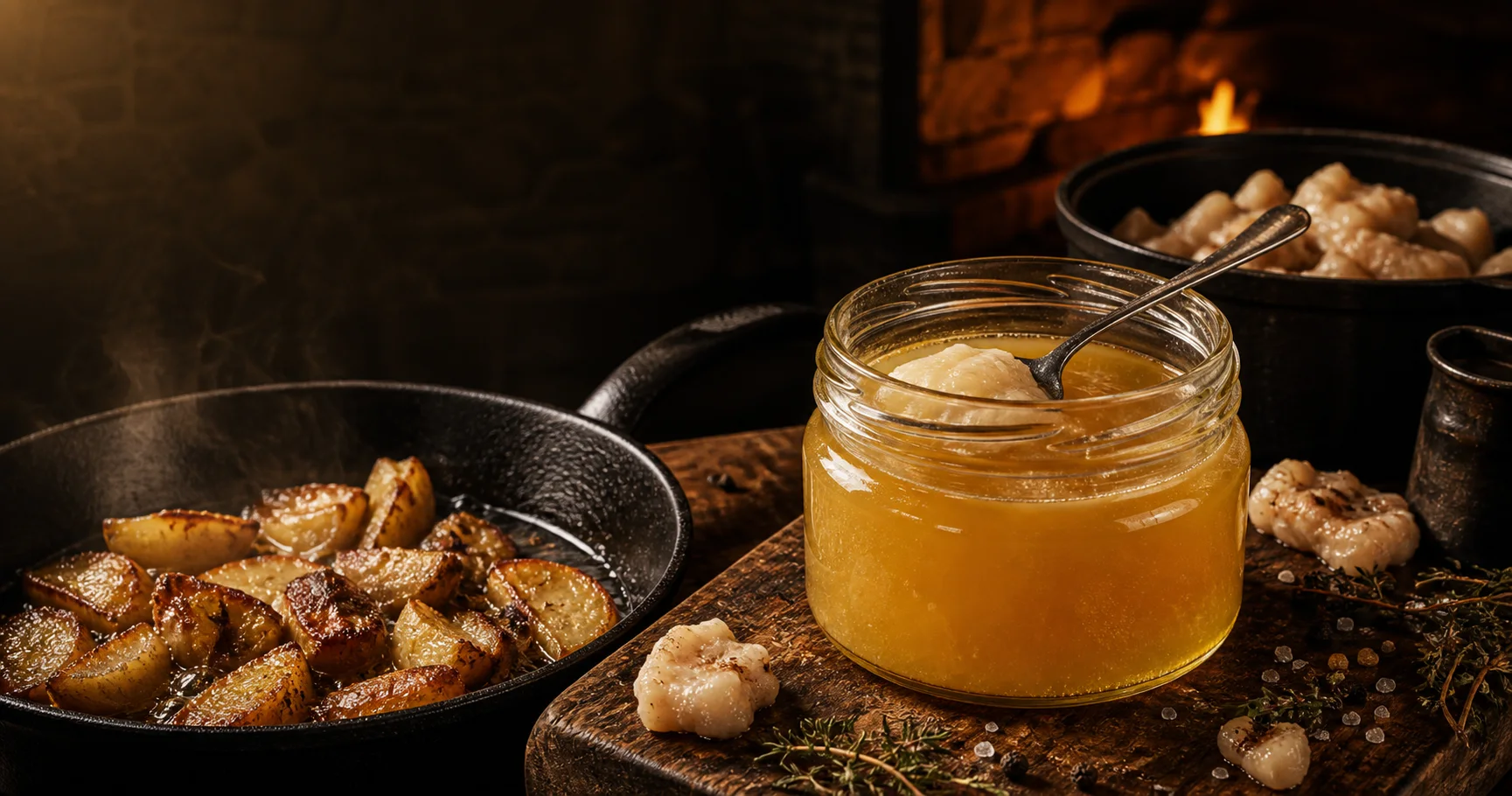
Why Did Beef Tallow Come Back?
Market and consumer context review: Amine Naini — Reviewed against cited public sources for: Traditional-fat revival, seed-oil backlash, frying nostalgia, and consumer demand for old cooking fats.
Review lanes show the scope checked for this case file. Active standalone case files present source-led historical context.
Why did beef tallow come back?
Verdict: Beef tallow came back because it lets modern eaters combine flavor nostalgia, traditional-fat identity, nose-to-tail cooking, and distrust of industrial oils in one ingredient. [1] [2] [3] [4]
Why it matters: The tallow comeback shows how cooking fats become cultural symbols, not just technical ingredients.
The Old Fat With New Politics
Beef tallow is not new. [1]
Beef tallow is not new. It is rendered cattle fat, historically used for frying, cooking, candles, soap, preservation, and household utility. What is new is the meaning attached to it. In the 2020s, tallow can signal tradition, flavor, anti-industrial food values, and nose-to-tail cooking.
That makes the comeback cultural as much as culinary. The fat did not simply return because people forgot it existed. It returned because people wanted what it symbolized.
Why Tallow Disappeared From Many Kitchens
Tallow lost ground as industrial vegetable oils, shortening, cost controls, nutritional messaging, and manufacturing convenience changed the fat landscape. [1]
Tallow lost ground as industrial vegetable oils, shortening, cost controls, nutritional messaging, and manufacturing convenience changed the fat landscape. Factory foods needed stable, standardized, scalable fats. Vegetable oils fit that system well.
Rendered animal fats remained in some cooking traditions, but many mainstream consumers came to see them as old-fashioned. The modern revival depends on reversing that emotional label.
Frying Nostalgia and Fast Food Memory
For many people, tallow nostalgia is really fry nostalgia. [1]
For many people, tallow nostalgia is really fry nostalgia. Fat carries flavor memory, especially in potatoes and fried foods. Stories about older fast-food frying practices have made beef tallow feel like a lost taste of the past, even when the memory is simplified.
This is why tallow's comeback is so clickable. It promises a return to something more flavorful, older, and less processed, whether or not every claim around it is historically perfect.
Why the Comeback Needs Careful Wording
The tallow case file should not claim that tallow is medically superior to other fats. [1]
The tallow case file should not claim that tallow is medically superior to other fats. That would pull the page into health advice. The stronger and safer story is that tallow is a symbolic cooking fat shaped by taste, trend cycles, distrust, sustainability language, and market positioning.
In other words, the comeback is real. The health mythology around it needs restraint.
Claim Graph
Evidence-Backed Claims
Each conclusion below carries a machine-resolvable proof path to the cited sources listed at the bottom of this page.