💡 Key Takeaways
- The hot dog is not a single clean invention; it combines German sausage traditions, American rolls, New York street vending, Coney Island leisure culture, and mass branding.
- German immigrants helped make frankfurters and wieners familiar in 19th-century American cities, especially through pushcarts, beer gardens, beaches, factories, and amusement districts.
- Coney Island turned the hot dog into spectacle: portable, cheap, fast, visible, and perfect for crowds moving between beaches, rides, boardwalks, and subway lines.
- The phrase "hot dog" was already circulating before Nathan's Famous, and food historians treat several origin stories, cartoons, and bun-invention legends cautiously.
- The modern hot dog became American through repetition: ballparks, July Fourth rituals, mustard, regional toppings, supermarket franks, roadside stands, and competitive eating culture.
What Is a Hot Dog?
A hot dog is usually a cooked sausage, often a frankfurter-style or wiener-style link, served in a split roll and eaten by hand. That sounds simple, but historically it is a composite food: German and Central European sausage craft, American bread rolls, street vending, mustard, crowd entertainment, factory meatpacking, baseball concessions, and regional toppings all compressed into one portable dish [1][2].
That is why the hot dog is stronger as a food-history subject than as a recipe. It sits beside bread, mustard, sauerkraut, beer, and bbq as a food that became cultural infrastructure. It is not only what people eat at a ballgame. It is a record of immigration, industrial meat, amusement culture, patriotic branding, and American arguments over what counts as "real" national food.
Where Did the Hot Dog Originate?
The hot dog has no single inventor. Its deepest roots are in German and Central European sausage traditions, especially frankfurters and wieners, which traveled with immigrants into 19th-century American cities [1][3]. Those sausages were already associated with skilled meat processing, urban eating, beer culture, and working-class convenience before they became American ballpark food.
The American hot dog emerged when those sausage traditions met bread rolls and street vending. New York, Coney Island, Chicago, St. Louis, and other cities all appear in origin stories, which is exactly why careful historians avoid pretending one person invented the entire food [1][6]. Coney Island matters because it made the hot dog visible at scale, but the food was built from older transatlantic parts: sausage knowledge, cheap urban meals, portable bread, and crowds hungry for fast food.
How German Sausage Became American Street Food
German immigration changed American foodways in the 19th century. Sausages, lager beer, delicatessens, beer gardens, picnic foods, and working-class eating habits entered cities through immigrant neighborhoods and public leisure spaces [2][3]. Hot sausages sold from carts or stands made sense in that world. They were filling, affordable, salty, and easy to eat standing up.
The name "hot dog" also belongs to this immigrant street-food setting. Bruce Kraig and other historians connect the phrase to late-19th-century jokes about dachshund-shaped sausages and suspicions about what went into cheap meat [1][5]. The point is not that Americans literally believed every sausage contained dog meat. It is that immigrant foods were often mocked before they were absorbed. A food could begin as foreign, comic, or suspicious and later become a national symbol.
Why Coney Island Made the Hot Dog Famous
Coney Island turned the hot dog into performance. Beaches, amusement rides, boardwalk crowds, subway access, sideshows, restaurants, and cheap snacks created the perfect environment for a food that could be eaten without a plate [4]. Charles Feltman is widely credited in Coney Island histories with helping popularize sausages served in rolls for beachgoers in the late 1860s and 1870s, though the broader bun-origin story has several competing versions [1][4][6].
That uncertainty is useful. It shows how food inventions are often cleaned up after the fact. The hot dog did not become famous because one genius placed one sausage into one roll. It became famous because Coney Island rewarded foods that were fast, portable, theatrical, cheap, and easy to repeat. A sausage in bread fit the machine: visitors could buy it, keep walking, watch a spectacle, ride a coaster, and buy another.
Nathan's Famous and the Power of Branding
Nathan Handwerker opened his Coney Island stand in 1916 after working in the Feltman orbit, and Nathan's Famous eventually became the most powerful hot dog brand in American memory [2][7]. Its importance was not pure invention. It was positioning: lower price, high visibility, a memorable location at Surf and Stillwell, and a product that matched the speed of Coney Island crowds.
Several Nathan's stories have become part of hot dog folklore, including tales about medical students or doctors used to reassure customers about cheap meat. The safest reading is that these stories belong to brand mythology and public trust-building, not to laboratory-grade documentation [1][2]. What matters historically is clearer: Nathan's helped prove that a cheap immigrant street food could become a national commercial icon through price, repetition, media attention, and ritual. The annual eating contest later made the brand even more theatrical.
How War, Baseball, and Mustard Made It American
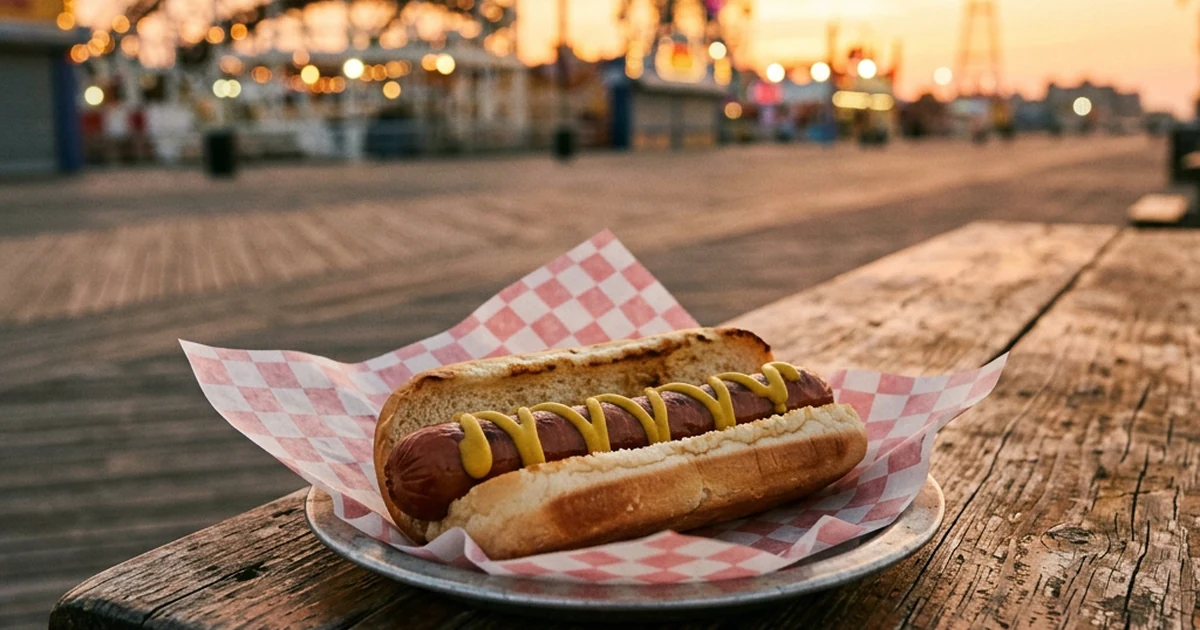
The hot dog became American through institutions that repeated it: ballparks, fairs, beaches, lunch counters, road trips, supermarkets, and July Fourth celebrations. Baseball was especially important because the hot dog solved a stadium problem. It was hot, salty, handheld, fast to sell, and easy to eat without leaving a seat. Mustard gave it sharpness; sauerkraut kept its German memory alive; onions, relish, chili, cheese, and regional sauces turned it into a local identity system.
World War I complicated German-associated foods in the United States. Anti-German sentiment pressured words, menus, and public identity, including foods like frankfurters and sauerkraut [2][3]. But the hot dog survived because it could be renamed, rebranded, and folded into American leisure. That is the central irony: a food built from German immigrant sausage traditions became patriotic precisely because American culture learned to forget, soften, or theatricalize its foreignness.
How Hot Dogs Are Used Today
Today hot dogs are less one food than a platform. A New York dirty-water dog with mustard and sauerkraut, a Chicago dog with sport peppers and neon relish, a Detroit Coney with chili sauce, a Sonoran dog wrapped in bacon, a ballpark dog with yellow mustard, and a Korean-style corn dog all belong to the same portable-food family while telling different regional stories [1][2].
That flexibility is why the hot dog endures. It can be cheap or nostalgic, mass-produced or local, ordinary or ceremonial. It absorbs toppings, migration, sports, summer rituals, convenience-store culture, and social media novelty without losing its basic shape. The hot dog is not simply "America's food." It is a lesson in how America turns immigrant food into national theater.
In the news
Recent 2026 food-culture notes that reference this article.
Historical Timeline
Frankfurters, wieners, and related sausages develop inside German and Central European sausage-making traditions.
German immigrants bring sausages, beer gardens, delicatessens, and street-food habits into American cities.
Coney Island vendors, including Charles Feltman in local histories, help popularize sausages served in rolls for beach crowds.
The phrase "hot dog" circulates in American slang and newspapers, partly through jokes about sausage ingredients and dachshund-shaped links.
Nathan Handwerker opens a nickel hot dog stand at Surf and Stillwell in Coney Island, later known as Nathan's Famous.
Anti-German sentiment pressures some foods and names, helping Americanize frankfurters, wieners, sauerkraut, and other German-associated foods.
Ballparks, fairs, supermarkets, drive-ins, roadside stands, and regional toppings turn hot dogs into a national food symbol.
The hot dog remains a flexible platform for regional identity, from Chicago-style dogs to Coney dogs, chili dogs, and Korean-style corn dogs.
Evidence Explorer
Review the Source Trail
Inspect the article sources, scoped review credits, and copyable citation details without leaving the page.
Reviewed for Stated Scope
Sources Listed
Comments
Community comments are coming soon. Check back later to join the discussion!