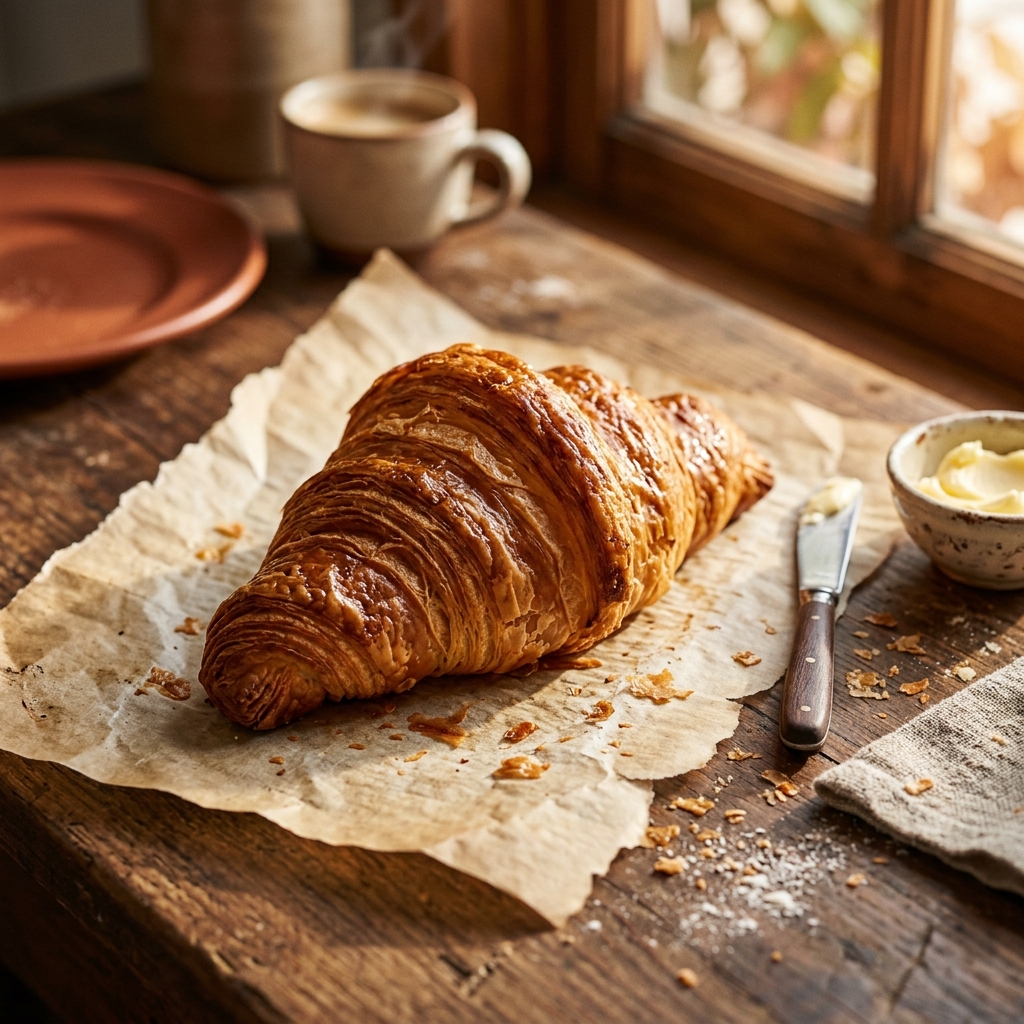
Is the Classic French Croissant Actually Austrian?
Source and factual review: Mehdi Iarab — Reviewed against cited public sources for: Austrian kipferl archives, Ottoman siege folklore, and 20th-century French yeast-dough lamination chemistry.
Review lanes show the scope checked for this case file. Active standalone case files present source-led historical context.
Is the classic French croissant actually Austrian?
Verdict: Yes, the iconic crescent shape and ancestral recipe of the croissant are Austrian, originating from the medieval Kipferl roll. However, the light, airy, flaky, laminated yeast-dough pastry we recognize today did not exist until French bakers in the early 20th century revolutionized the recipe by applying French puff-pastry lamination techniques to the Austrian import.
Why it matters: The croissant is a classic example of culinary hybridization, showing how a heavy foreign roll was systematically refined by French pastry techniques to create a modern luxury staple.
The Myth of the Tunneling Bakers and the Ottoman Siege
The most famous story surrounding the croissant is battlefield folklore. According to legend, during the Ottoman Siege of Vienna in 1683, Turkish soldiers attempted to dig tunnels underneath the city walls at night. Viennese bakers, working early, supposedly heard the digging, raised the alarm, and saved the city. In celebration, the bakers created a crescent-shaped roll mimicking the crescent moon associated with the Ottoman army.
The problem is chronology. Crescent-shaped rolls, known as Kipferl or Kipfel in German-speaking lands, appear in food-history accounts well before the Ottoman-siege legend. Some accounts place Austrian crescent rolls as early as the 13th century. That does not mean the modern croissant already existed. It means the crescent shape cannot be explained only by a late-17th-century siege story.
August Zang and the Parisian Boulangerie Viennoise
The actual migration of the Kipferl from Vienna to Paris is attributed to a highly enterprising Austrian artillery officer named August Zang. In the late 1830s (most historians point to 1839), Zang retired from the military and opened the Boulangerie Viennoise at 92, rue de Richelieu in Paris. He imported high-quality Austrian wheat flour, installed revolutionary steam-injection ovens, and introduced Parisians to Viennese specialty breads, including the crescent-shaped Kipferl.
Zang’s bakery was a sensational success, attracting the elite of Parisian society. The delicate, buttery texture of his pastries captivated local bakers, who quickly began imitating Zang’s crescent rolls. Because of their curved shape, Parisians referred to them simply as croissants (crescents). However, Zang’s 1839 croissant was not the flaky pastry we eat today; it was made of a heavy, brioche-like, rich milk-and-yeast dough, closely resembling the modern Austrian Kipferl.
The 20th-Century Butter Lamination Revolution
The crucial transformation that created the modern, airy, shatteringly crisp croissant occurred in the early 20th century. French bakers took the yeast-leavened crescent roll and merged it with laminated dough technique: layers of dough and butter repeatedly rolled, folded, chilled, and baked into a honeycomb of crisp sheets.
Sylvain Claudius Goy's 1915 La Cuisine Anglo-Américaine is often cited as a key early printed recipe for the modern laminated croissant, though food historians continue to compare earlier and later recipe evidence. The careful conclusion is that the croissant is both Austrian and French: the crescent-roll ancestry is Viennese, while the flaky butter-laminated pastry became a French bakery form.