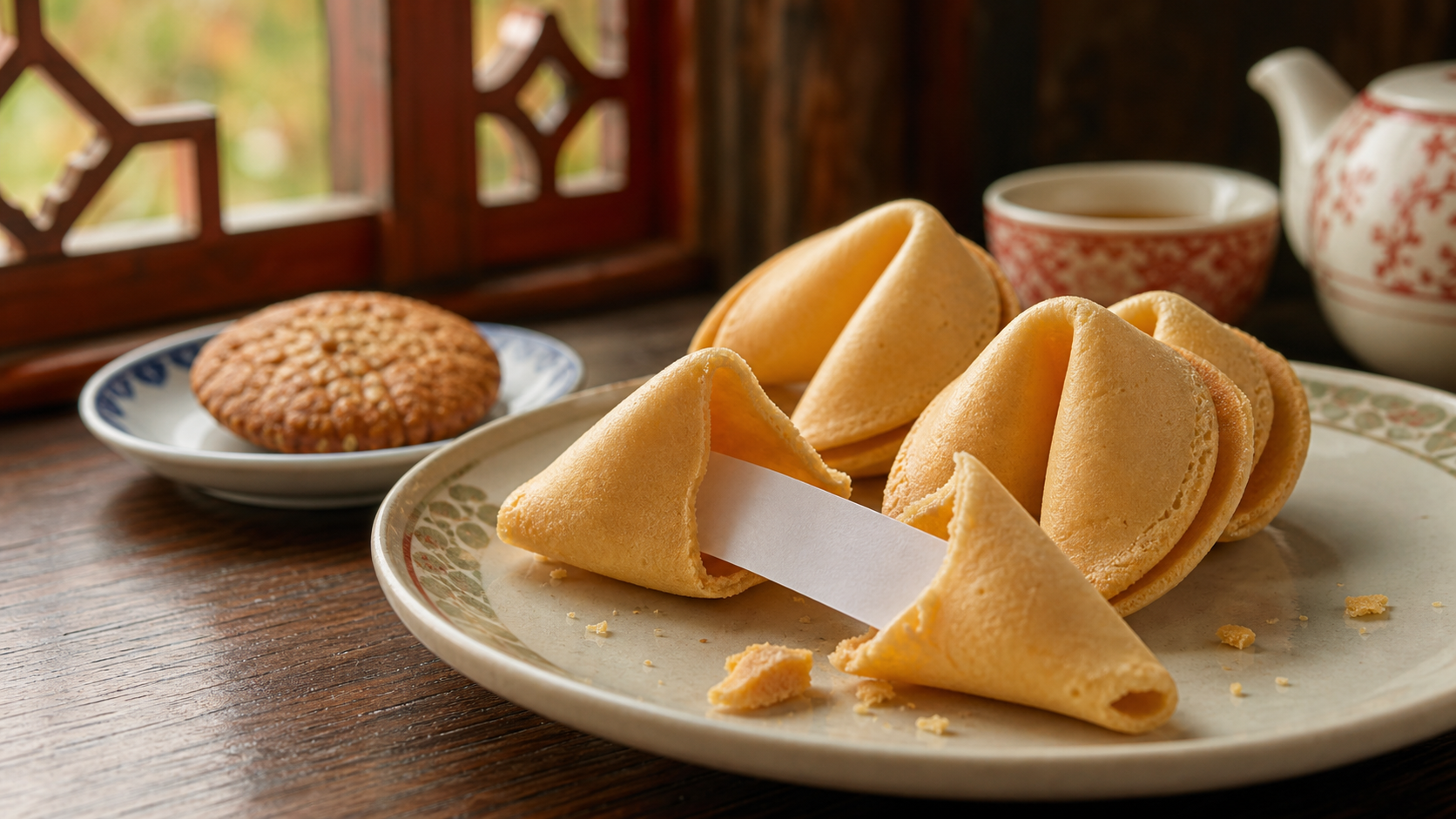
Are Fortune Cookies Chinese?
Digital culture and storytelling context review: Ahmed Baakli — Reviewed against cited public sources for: Takeout myth storytelling, Chinese-American restaurant ritual framing, and shareable gotcha boundaries.
Review lanes show the scope checked for this case file. Active standalone case files present source-led historical context.
Are fortune cookies Chinese?
Verdict: No. Fortune cookies descend from Japanese fortune crackers, were remade in California tea gardens and bakeries, and became “Chinese” because Chinese-American restaurants made them a national takeout ritual.
Why it matters: The cookie is a clean lesson in how origin myths attach to the restaurant door you meet — not always to the first baker. It is identity history, not a dunk on Chinese food.
The Verdict in One Sentence
Fortune cookies are not a traditional dessert brought from China. The best-supported history connects them to Japanese fortune-bearing crackers, early twentieth-century California businesses, and the Chinese-American restaurants that made the cookie a nationwide after-dinner ritual [1][2].
That does not make the cookie culturally meaningless or turn Chinese-American restaurants into impostors. It means the product has several layers of identity. Its closest documented cracker ancestors are Japanese; its modern restaurant form is American; its most influential service culture is Chinese-American. The myth arose because diners naturally associated the cookie with the restaurants where they repeatedly received it.
Evidence Older Than the California Claims
A Japanese illustrated work published in 1878 shows a cracker maker producing a folded fortune-bearing sweet recognizably related to the later cookie [1][3]. Japanese crackers often discussed as *tsujiura senbei* could be darker, larger, and less sweet than the American version, but their combination of crisp dough and a paper fortune makes them the strongest known antecedent.
This evidence predates the best-known San Francisco and Los Angeles inventor stories. It does not prove an unchanged recipe traveled intact from one Japanese bakery to every American restaurant. It establishes something narrower and stronger: the idea of a folded cracker carrying a fortune existed in Japan before California businesses popularized the modern U.S. cookie.
What California Businesses Actually Added
Smithsonian research connects the Benkyodo confectionery to cookies supplied for San Francisco's Japanese Tea Garden by 1906 [1]. Other histories identify Makoto Hagiwara, Los Angeles confectioner Seiichi Kito, and David Jung of the Hong Kong Noodle Company as important claimants [2][3]. The paper trail does not make one person the uncontested inventor of every feature.
Those claims are best treated as different contributions to American commercialization. California producers made a thinner, sweeter wafer suited to restaurant service. They connected the cracker to tourism and dining, and later machinery made rapid folding and national distribution possible. The California story is therefore a documented adaptation story, not evidence for an ancient Chinese dessert.
How War Complicated the Restaurant Handoff
During World War II, the United States forcibly incarcerated people of Japanese ancestry and disrupted Japanese-American homes and businesses. Fortune-cookie bakeries existed within that commercial world. Chinese-American restaurants increasingly served the cookie during and after this period as their own national restaurant network expanded [1][2][4].
The evidence supports including incarceration in the explanation, but not reducing the entire handoff to a single event. Restaurant supply chains, customer expectations, mechanized baking, and earlier cross-community exchange also mattered. Saying that Chinese restaurants simply “stole” the cookie would replace one myth with another and erase the pressures facing both Japanese-American and Chinese-American businesses.
Why the Chinese Association Became So Strong
For millions of diners, the fortune cookie arrived with the check at a Chinese restaurant. Its printed message also matched an American fantasy of portable “Eastern wisdom.” Repetition turned that setting into an origin story. By the time mass producers supplied restaurants across the country, the association felt older than it was.
Chinese-American restaurants did more than pass along somebody else's cracker. They gave the cookie its dominant social meaning: breaking it together, reading the sentence aloud, comparing fortunes, and treating it as the end of a shared meal. That ritual is historically Chinese-American even though the cracker lineage is not traditionally Chinese [4].
Final Finding
The claim “fortune cookies are Chinese” is inaccurate when it means the cookie is a traditional dessert originating in China. The better finding is Japanese cracker ancestry, California reinvention, and Chinese-American restaurant adoption. No single inventor story accounts for all three stages.
That layered verdict is more useful than a national gotcha. It recognizes Japanese-American confectioners, the damage of wartime incarceration, Chinese-American restaurant entrepreneurship, and the industrial systems that turned a regional sweet into a national custom. The full [fortune cookie history](/food/fortune-cookie) follows those stages in greater depth.