Who Invented General Tso's Chicken?
Source and factual review: Mehdi Iarab — Reviewed against cited public sources for: Peng Chang-kuei chronology, NYC adaptation claims, Zuo Zongtang naming, and non-recipe authenticity boundaries.
Review lanes show the scope checked for this case file. Active standalone case files present source-led historical context.
Who invented General Tso's chicken?
Verdict: Chef Peng Chang-kuei developed an early General Tso’s chicken in Taiwan; New York Chinese-American kitchens sweetened the crispy takeout form Americans know. The dish is named for Qing general Zuo Zongtang, who never ate it.
Why it matters: Authenticity fights flatten a migration story into “fake vs real.” The useful history is chef invention, diaspora remake, and prestige naming — not a recipe dump.
The Short Answer
Chef Peng Chang-kuei has the strongest documented claim to an early dish named for General Tso. He developed it in Taiwan after leaving mainland China. New York restaurants then changed the balance toward the sweeter, crispier takeout version familiar across North America [1][2][3].
That answer separates three roles often collapsed into one. Zuo Zongtang supplied the famous name but had no documented connection to the recipe. Peng supplied the foundational modern dish. Chinese-American cooks and restaurant operators supplied the adaptation and distribution that made it famous. “Who invented it?” therefore has a leading answer, but the standard American plate has more than one authoring stage.
The General Was Real, but the Recipe Link Was Not
Zuo Zongtang was a nineteenth-century Qing official and military leader from Hunan. Older romanization made his name familiar in English as Tso Tsung-t’ang or General Tso. There is no evidence that he ate the modern dish, commissioned it, or left behind a household recipe that became the restaurant chicken [1][2].
The name functions as regional and prestige branding. Peng was Hunan-born, and naming a banquet dish for a prominent Hunanese figure gave it an immediate historical identity. This is common in menu history: a famous person can lend a dish status without being its eater or inventor.
What the Evidence Says About Peng Chang-kuei
Peng Chang-kuei left Hunan for Taiwan after the Chinese Civil War and became an influential banquet and restaurant chef. Accounts vary on the exact date and occasion of his first General Tso-named chicken; some place it at a government banquet in the 1950s. The consistent evidence identifies Peng and Taiwan as the central early setting [1][2][5].
Peng’s version drew on Hunanese flavor preferences but was not a documented ancient household dish. It was reportedly less sweet than the later American standard. The uncertainty around one banquet date should not be used to erase the stronger biographical evidence, but it does mean responsible history should avoid presenting a disputed day as settled fact.
How New York Reauthored the Plate
Peng opened a New York restaurant in 1973, placing his dish inside a rapidly changing Chinese dining scene. Other restaurateurs and chefs, including figures associated with Shun Lee, are part of competing claims about the sweeter Manhattan version [1][3]. The disagreement is evidence of adaptation, not proof that every claimant invented an unrelated food.
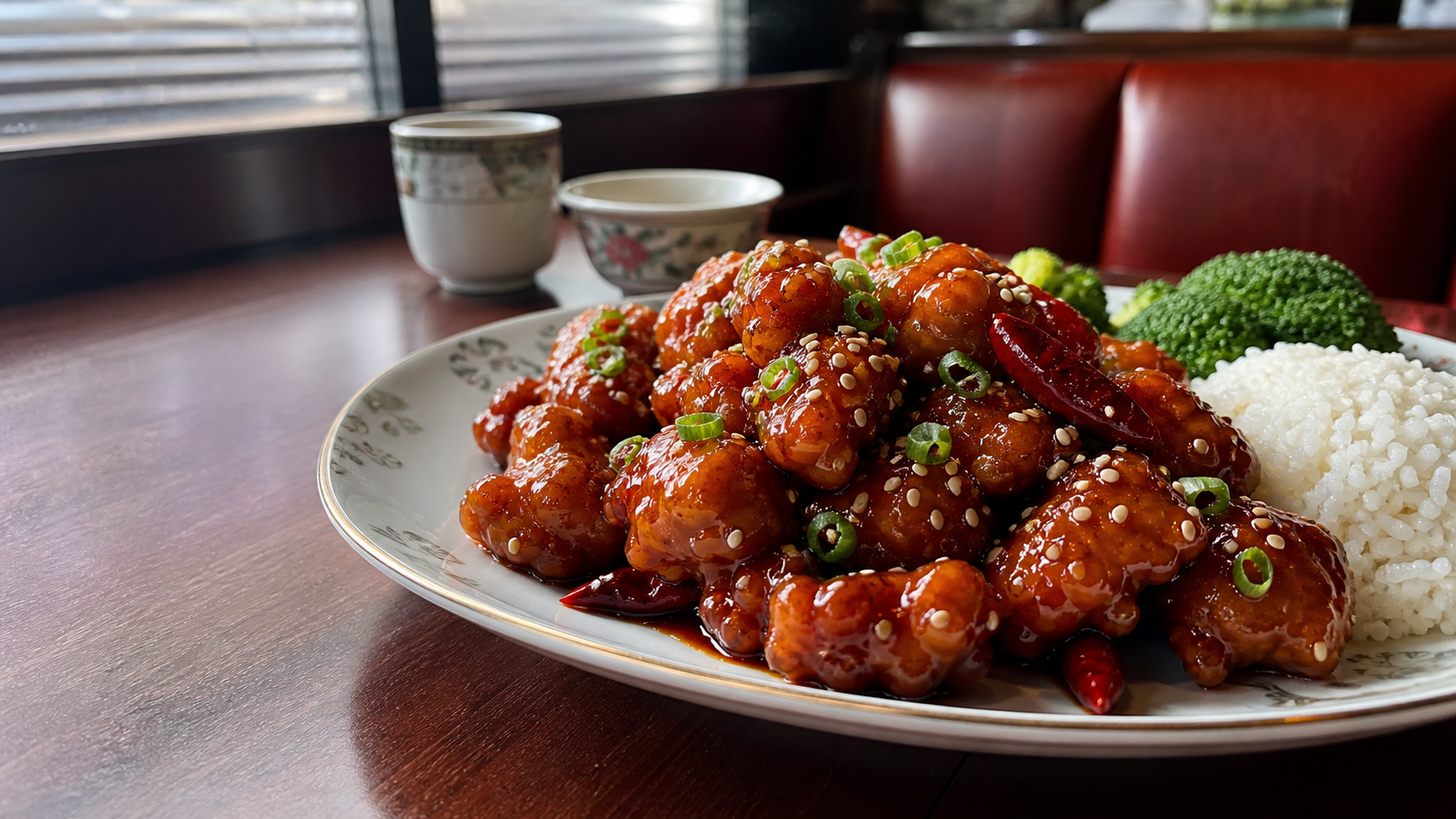
New York kitchens pushed the dish toward a crisp coating, thicker glaze, and more pronounced sweetness. Those choices suited American expectations and restaurant service. The chicken stayed recognizable under sauce, traveled through takeout, and occupied a premium place on standardized menus. What became nationally famous was therefore not Peng’s Taiwan plate unchanged.
Does “Chinese-American” Mean Fake?
No. The standard plate is not an old everyday Hunan recipe, but that does not make it historically fraudulent. Chinese-American cuisine was created by cooks working under migration, exclusion, labor, customer demand, and local ingredient constraints. Its dishes document those conditions.
Calling General Tso’s ancient Hunan food obscures Peng and New York. Calling it merely fake American food obscures Chinese-American authorship. Fuchsia Dunlop’s work on Hunan cooking helps show the distance between regional Hunan cuisine and the takeout plate without denying their relationship [4].
Final Finding
Peng Chang-kuei is the best-supported inventor of the early named dish in Taiwan. New York Chinese-American restaurants collectively shaped the sweet-crisp version that spread across the continent. General Tso himself did not invent or eat it. The remaining uncertainty concerns precise first-service claims and recipe adjustments, not the larger Taiwan-to-New York trajectory documented across the sources.
This finding allows credit to be specific: Peng for the foundational modern dish, New York cooks for adaptation, and Chinese-American restaurant networks for popularization. The full [General Tso’s chicken history](/food/general-tsos-chicken) explains the banquet, takeout, and authenticity contexts in greater depth.