💡 Key Takeaways
- Chef Peng Chang-kuei is widely credited with creating an early General Tso's chicken in Taiwan, drawing on Hunanese flavors rather than copying an old Hunan household recipe.
- New York restaurants in the 1970s made the dish sweeter and crispier, creating the takeout form familiar across North America.
- The name honors Qing military leader Zuo Zongtang, conventionally rendered General Tso in older romanization; there is no evidence that he ate the modern dish.
- Calling the dish either ancient Hunan food or simply fake American food misses the creative history of diaspora restaurants.
What Is General Tso's Chicken?
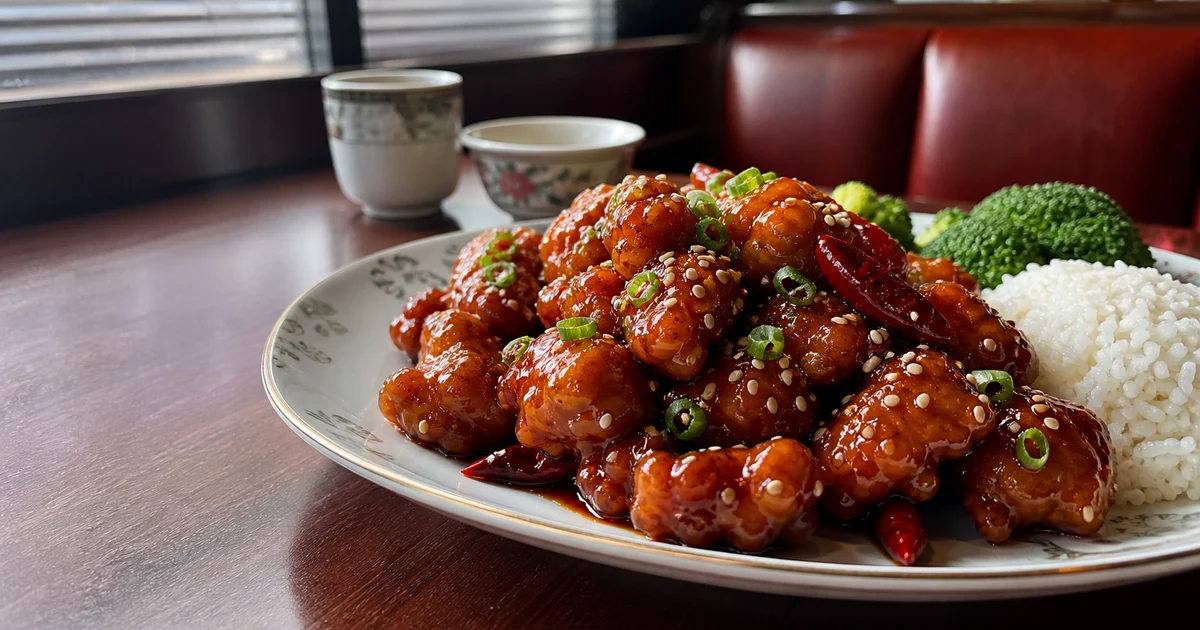
General Tso's chicken is a Chinese-American restaurant dish built from pieces of chicken that are battered or coated, fried until crisp, and finished in a glossy sauce balancing sweetness, savory seasoning, acidity, and chile heat. Broccoli and steamed rice are common North American companions, though neither defines the original account.
The dish is often described through a false choice. One version calls it an ancient Hunan classic carried unchanged to America. Another dismisses it as fake Chinese food. The historical record supports neither extreme. Its name and early form are associated with Hunan-born chef Peng Chang-kuei working in Taiwan, while the sweet, crisp takeout version developed through New York's Chinese restaurant culture [1][2][3].
That makes the plate a diaspora creation: connected to Chinese ingredients and cooking knowledge, invented outside Hunan, then altered again for a different restaurant market. Its history is not evidence that Chinese-American food lacks authenticity. It shows that immigrant cuisines remain inventive after migration.
Who Was General Tso?
General Tso is an older English rendering of Zuo Zongtang, a 19th-century Qing official and military leader from Hunan. He took part in campaigns that helped preserve Qing authority during a period of rebellion and imperial pressure. His historical importance made his name culturally resonant, especially for a Hunan-born chef seeking a distinguished title.
There is no evidence that Zuo ate the modern dish or inspired a family recipe that became the restaurant plate [1][2]. He died in 1885, decades before Peng's creation. The link is naming, not consumption. Attaching an eminent person's name to a dish can supply regional identity and prestige without describing literal authorship.
This distinction is one of the page's clearest answers for searchers. The general was real, but the culinary connection was created later. Food names routinely compress memory in this way, turning rulers, places, patrons, and legends into shorthand on a menu.
Peng Chang-kuei and the Taiwan Origin
Peng Chang-kuei, a Hunan-born chef who relocated to Taiwan after the Chinese Civil War, is widely credited with the foundational dish. Accounts differ on the exact occasion and year. Some connect it to a government banquet in the 1950s; other retellings are less specific. What remains consistent is Peng's central role and the Taiwan setting [1][2][5].
Peng's chicken drew on a Hunanese preference for bold savory, sour, and hot flavors, but it was a chef's banquet composition rather than a documented old household staple. Early descriptions emphasize a flavor profile less sugary than the American version. The dish's prestigious name tied it to Peng's home province through Zuo Zongtang.
It is safer to call Peng the best-supported creator of an early General Tso's chicken than to assign a perfectly precise birthday unsupported by surviving menus. That wording preserves both the evidence and the uncertainty.
How New York Changed the Dish
New York transformed General Tso's chicken from an individual chef's dish into a restaurant category. Peng opened a Manhattan restaurant in 1973. At roughly the same time, other ambitious Chinese restaurants were presenting regional cuisines to diners accustomed to Cantonese-American standards. The dish entered a market where kitchens watched one another, customers rewarded memorable sweetness and crunch, and recipes changed quickly [1][3][6].
Restaurateur Ed Schoenfeld and chef T. T. Wang of Shun Lee are part of competing New York accounts. Rather than proving that Peng had no role, their story illustrates adaptation: restaurants adjusted sauce, frying, and presentation until an American standard emerged. The familiar version became sweeter, its coating crisper, and its sauce thick enough to cling during table service or takeout.
These were functional choices as well as taste choices. Fried pieces kept their identity under sauce; sweetness broadened appeal; a bold red-brown glaze photographed and traveled well; broccoli made a recognizable plate. Restaurant economics helped define what diners later treated as the original.
Why It Spread Through Chinese-American Takeout
By the late 20th century, independent Chinese-American restaurants used overlapping menu formats that made successful dishes easy to recognize from city to city. General Tso's chicken fit that system. It could be produced from familiar pantry ingredients, priced as a special entree, and adjusted from mildly sweet to noticeably hot without losing its identity.
The dish also joined a broader grammar: white cartons, combination plates, fried rice, egg rolls, and the fortune cookie. None of those elements alone defines Chinese-American cuisine, but together they created a dependable restaurant experience. General Tso's became both a food and a category signal - the glossy, indulgent chicken dish customers could order without explanation.
Its spread should not be reduced to American customers forcing cooks to abandon authenticity. Chinese-American operators actively built dishes that supported their businesses and communities. Adaptation was labor, judgment, and authorship, even when the resulting plate differed sharply from cooking in Hunan.
Why Competing Origin Stories Survive
General Tso's chicken became famous through restaurants, not through a centralized manufacturer that preserved one formula and one release date. Recipes moved between chefs, employees changed kitchens, menu language circulated, and successful combinations were imitated. That environment naturally produces overlapping memories of who served what first.
The claimants also answer different questions. Peng's biography addresses who created the foundational named dish. Shun Lee accounts address who helped shape an influential New York version. Thousands of neighborhood restaurants address who standardized and popularized the takeout plate. Treating only one of those achievements as "invention" makes the other stages disappear [1][3][5].
Later documentaries and articles made the dispute compelling because Peng reportedly encountered an Americanized version unlike his own [2][5]. That scene symbolizes a real process even if it cannot settle every menu claim: a chef can originate a dish and then watch a market reauthor it. The survival of multiple stories is not proof that no history exists. It is evidence that culinary authorship can be cumulative.
Is General Tso's Chicken Authentic Chinese Food?
If "authentic" means an old everyday recipe from Hunan, the standard American dish does not qualify. If it means a historically real expression of Chinese migration, restaurant craft, and Chinese-American life, dismissing it as fake is equally inaccurate [4][6][7].
The ingredients and techniques have multiple lineages. Chicken, starch coating, frying, soy seasoning, vinegar, sugar, garlic, and chile pepper can all be placed inside Chinese cooking histories. Their proportions and service style reflect Taiwan and the United States. That combination is precisely what diaspora cuisine does: it makes food under new conditions without becoming historically meaningless.
Fuchsia Dunlop's work on Hunan cooking helps reveal the contrast between the regional cuisine and its American namesake [4]. The contrast should invite curiosity rather than a purity test. One can recognize Hunan food, Peng's banquet invention, and Chinese-American takeout as related but distinct culinary worlds.
Who Invented General Tso's Chicken?
Peng Chang-kuei has the strongest claim to the named dish's early form in Taiwan. New York cooks and restaurateurs then reshaped it into the sweet-crisp version that became nationally famous. Zuo Zongtang supplied the name but did not invent or eat it. That three-part answer is more accurate than a single dramatic invention date.
It also explains why origin debates persist. People are often asking three different questions: Who first used the name? Who created the American flavor profile? Who made it nationally popular? Those achievements can belong to different actors, especially when recipes circulate between restaurants without formal ownership records.
The enduring history is therefore Peng's authorship, New York's adaptation, and Chinese-American restaurants' distribution. The focused Case File audits the inventor claims and the general's connection in a shorter evidence-led format.
Historical Timeline
Zuo Zongtang, the Hunan-born Qing official later rendered as General Tso, lives without any documented connection to the chicken dish
Chef Peng Chang-kuei develops a General Tso-named chicken in Taiwan after leaving mainland China
Peng opens a restaurant in New York, bringing his version into a competitive Chinese dining scene
New York adaptations become sweeter, crispier, and increasingly standardized for American restaurant service
General Tso's chicken spreads through takeout menus across the United States and Canada
Evidence Explorer
Review the Source Trail
Inspect the article sources, scoped review credits, and copyable citation details without leaving the page.
Reviewed for Stated Scope
Sources Listed
Comments
Community comments are coming soon. Check back later to join the discussion!