💡 Key Takeaways
- Mace is the dried aril around the nutmeg seed, not a separate plant.
- Both spices were once native to the Banda Islands.
- European monopoly campaigns targeted Bandanese people and their control of the trees.
- Transplantation later created production in other colonies, including Grenada.
What Is Mace?
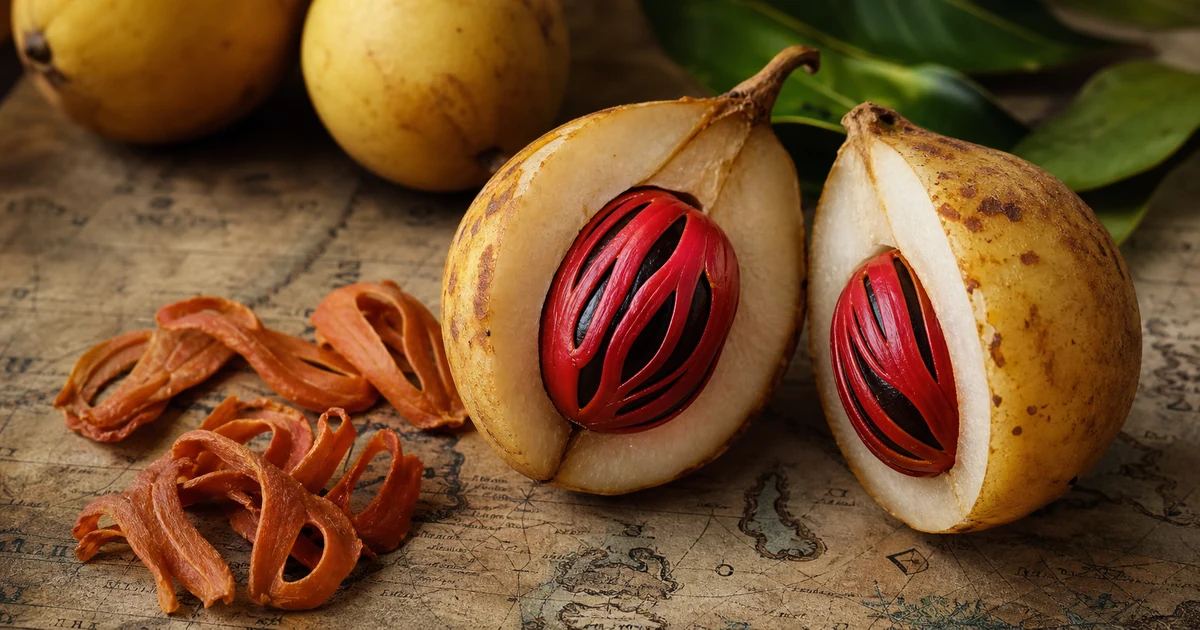
Mace is the aril, a lacy covering that wraps the seed of Myristica fragrans. The seed becomes nutmeg; the aril is peeled away and dried as mace [3][4]. They are therefore sibling spices from one fruit, not interchangeable names.
Fresh mace is often crimson. Drying flattens and changes it into orange-yellow blades with a warm aroma distinct from nutmeg.
Banda and a Botanical Monopoly
Before transplantation, nutmeg trees grew naturally in the Banda Islands. Bandanese communities cultivated, harvested, and traded nutmeg and mace through regional networks reaching Java, India, the Middle East, and Europe [2].
European consumers knew the spices but not always their precise source. That distance encouraged fantasies of secret islands while Asian merchants managed the actual commerce.
The Violence Behind VOC Control
The Dutch East India Company sought exclusive supply. In 1621, Jan Pieterszoon Coen’s campaign killed, expelled, enslaved, or displaced much of Banda’s population and reorganized production under colonial control [1][2].
Mace history cannot be reduced to price charts. Monopoly depended on military force and the seizure of land and trees.
Transplanting the Tree
European rivals and botanical transfers moved Myristica fragrans beyond Banda. Cultivation in Southeast Asia, the Caribbean, and especially Grenada weakened the VOC’s geographic control while creating new plantation systems [1][3].
The fruit became a global crop, but its original Bandanese history remained obscured in many spice cabinets.
Mace in the Kitchen Today
Mace seasons sausages, sauces, baked goods, rice, pickles, soups, and spice blends. Its blades can be infused whole or ground. Industrial grading values color, cleanliness, oil, and origin.
Every piece records a botanical relationship and a political one: seed and aril grew together, while empires separated producers from control of both.
Historical Timeline
Nutmeg and mace move from Banda through Asian and Indian Ocean merchant networks
Dutch conquest and mass violence in Banda enforce VOC control over nutmeg and mace
Trees are transferred to other colonial territories, eroding geographic monopoly
Indonesia and Grenada remain strongly associated with nutmeg and mace production
Evidence Explorer
Review the Source Trail
Inspect the article sources, scoped review credits, and copyable citation details without leaving the page.
Reviewed for Stated Scope
Sources Listed
Comments
Community comments are coming soon. Check back later to join the discussion!