Why Do We Call Them French Fries If Belgium Claims They Invented Them?
Source and factual review: Mehdi Iarab — Reviewed against cited public sources for: Debunking the Namur frozen-river legend and auditing 18th-century Parisian Pont-Neuf street vendor records.
Review lanes show the scope checked for this case file. Active standalone case files present source-led historical context.
Why do we call them ‘French’ fries if Belgium claims they invented them?
Verdict: The name "French" almost certainly comes from the French *cut* or frying technique — and from US soldiers eating Belgian frites in WWI — not because France invented the fry. The strongest origin evidence points to Belgian Meuse-Valley fried-potato tradition, while 18th-century Parisian street vendors and the spread of "French fried potatoes" in English explain how the word attached itself.
Why it matters: The naming puzzle and the origin puzzle are two different questions. Belgium most plausibly invented fried potatoes; the word "French" stuck for reasons of technique, language, and wartime — a useful reminder that a food's name rarely names its birthplace.
The Frozen River of Namur: Fact or Folklore?
The cornerstone of the Belgian claim is a charming, widely cited family legend popularized in the 20th century by the Belgian journalist Jo Gérard. Gérard claimed to have found a family manuscript describing residents along the River Meuse near Namur, Huy, and Dinant. According to the story, local people fried small fish from the river; when the Meuse froze during a hard winter, they supposedly carved potatoes into fish-like strips and fried those instead.
Food historian Pierre Leclercq has shown why this story should be handled as folklore rather than firm origin evidence. His critique points to two major problems: potatoes were not yet established in the Namur region at the legendary date, and deep-frying required fat that was expensive for poor rural households. The Namur story remains culturally important because Belgians truly made fries central to national food identity, but it is not strong enough to serve as the secure birth certificate of the modern fry.
The Street Peddlers of Paris's Pont-Neuf
If the Belgian frozen-river myth is weak, where does the documented trail lead? Leclercq points toward the commercial food world of Paris, where street vendors and cooks had access to frying equipment, urban customers, and enough fat to sell fried foods at scale. Late-18th-century Paris was full of open-air food sellers, and Louis-Sébastien Mercier's Tableau de Paris remains an important witness to that street economy.
The exact shape of early pommes de terre frites is still a careful question. Many early recipes describe slices or rounds, not necessarily the long rectangular batons familiar today. Thomas Jefferson later returned from France with a recipe for pommes de terre frites a cru en petites tranches, which Monticello translates as deep-fried potatoes in small cuttings. His notes are perhaps one of the earliest American references to the dish, but they also remind us that early fried potatoes were not always identical to the modern fry.
How Belgium Perfected the Crispy Double-Fry
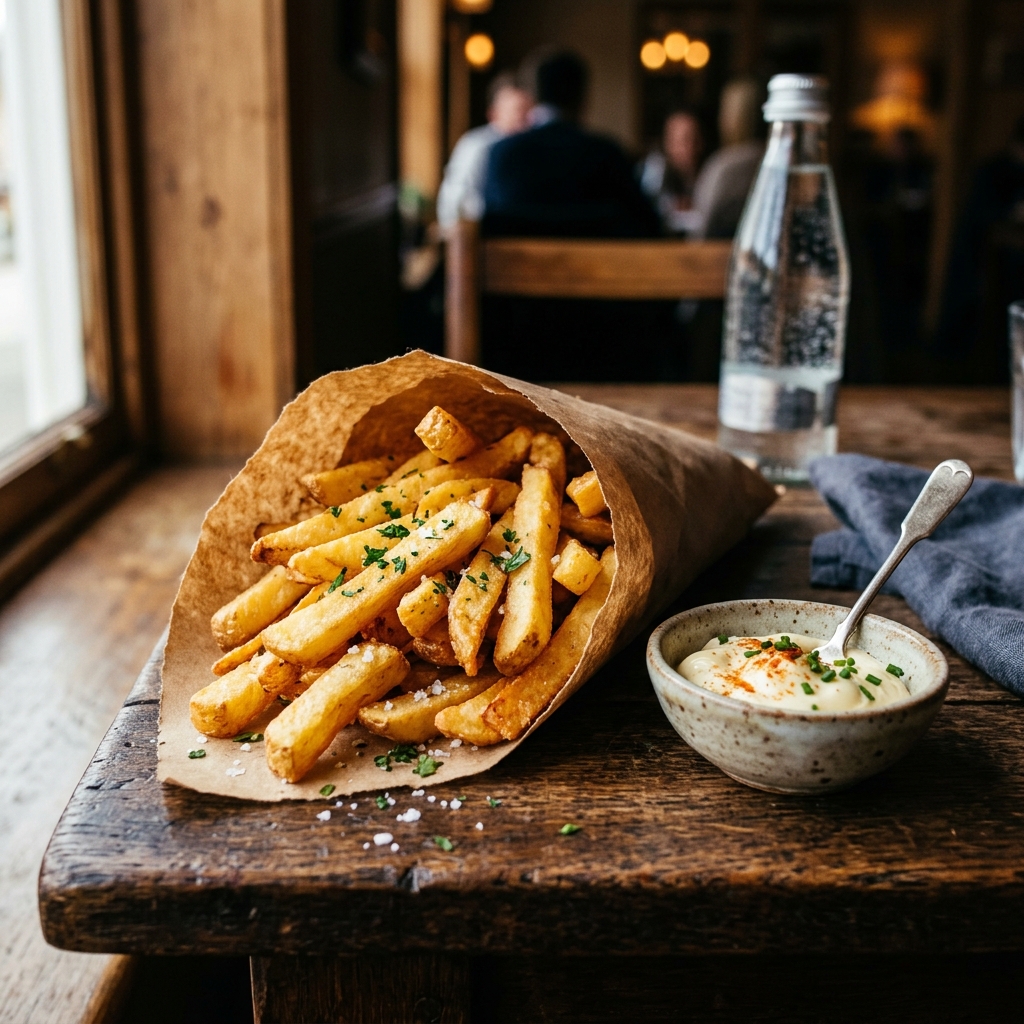
Belgium enters the story not as a footnote, but as the culture that made the frite iconic — and most plausibly invented it. By the 19th and 20th centuries, fry stands, paper cones, sauces, and repeated public debate over fry origins helped turn the potato fry into a Belgian national symbol. Leclercq also connects the Belgian fairground tradition to figures such as Frédéric Krieger, known as Fritz, whose stands helped popularize fried potatoes in Belgium.
The double-cooking method is central to modern Belgian fry identity: potatoes are cooked first at a lower temperature to soften the interior, rested, and then fried again at a higher temperature to crisp the surface. The honest conclusion is that the strongest origin evidence points to Belgium's Meuse-Valley fried-potato tradition, while France contributed the urban street culture and the naming — the word "French" most likely refers to the French cut or frying technique, reinforced by US soldiers eating Belgian frites in WWI. Two countries, two contributions, one fry.