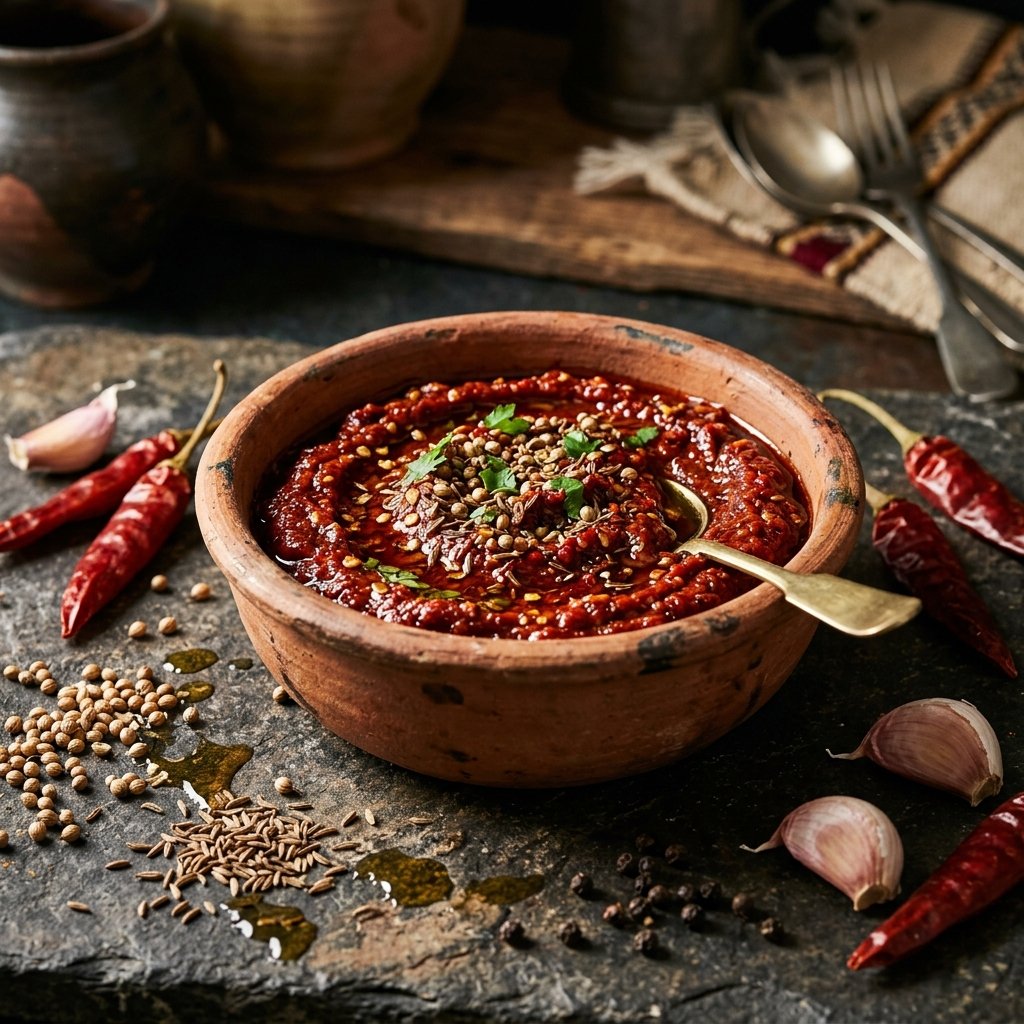
The Red Paste of War: How Expelled Andalusian Refugees and Clashing Empires Accidentally Created Harissa
Historical Origin and Migration Audit: Ahmed Baakli — Reviewed against cited public sources for: Columbian exchange trade routes, Spanish occupation of Tunis, the 1609 Morisco expulsion, and Maghrebi spice history.
Review lanes show the scope checked for this case file. Active standalone case files present source-led historical context.
Did harissa originate as a generalized "North African" paste?
Verdict: No. Harissa has hyper-local roots in Tunisia, specifically the Cape Bon peninsula, where it was born in the 16th century following the Spanish occupation of Tunis. Britannica and other general sources fall short by describing it broadly as a "North African" paste. While it is eaten across the Maghreb, its traditional Tunisian preparation and social practices are so distinct they were inscribed on UNESCO's Representative List of the Intangible Cultural Heritage of Humanity in 2022.
Why it matters: This case study exposes how broad encyclopedic definitions can strip culinary staples of their hyper-local identity and national pride. It also reveals how imperial wars and forced migrations shape the foods we treat as cultural heritage.
The Broadness of "North African" Condiments
In its entry for harissa, the Encyclopaedia Britannica defines it generally as a "spicy North African paste." While technically true in a broad geographic sense, this definition strips the condiment of its hyper-local identity. Harissa is not a generic regional staple. It is the national culinary symbol of Tunisia. Making and consuming traditional Tunisian harissa is so deeply tied to Tunisian identity and cultural pride that in 2022, the traditional knowledge and artisanal skills of Tunisian harissa-making were officially inscribed on UNESCO's Representative List of the Intangible Cultural Heritage of Humanity.
Furthermore, using a broad term like "North African" overlooks the distinct culinary differences between Maghreb nations. In Tunisia, harissa is an essential foundation cooked directly into almost every stew, sauce, and soup. In neighboring Morocco, it is rarely cooked into dishes but is served on the side as a table condiment, much like mustard.
The Clash of Empires and the Columbian Exchange
The actual creation of harissa was triggered by early modern global trade and military conflicts between the Spanish and Ottoman Empires. Chili peppers (Capsicum family) are entirely native to the Americas and did not exist in the Mediterranean before the 16th century. Between 1535 and 1574, Spain occupied Tunis and key ports along the Tunisian coast. Spanish soldiers and merchants brought Mesoamerican chili seeds across Atlantic trade routes to the region. The seeds were planted in the fertile soils of the Cape Bon peninsula (specifically around Nabeul), where the microclimate caused them to adapt over decades, mutating into the unique, sweet-and-smoky Baklouti pepper that defines authentic Tunisian harissa today. Far from being an ancient, static paste, harissa was born from the biological transfer of the Columbian Exchange.
The 1609 Morisco Refugee Influx
In 1609, King Philip III of Spain ordered the brutal expulsion of the Moriscos (Spanish Muslims and Jews who had been forced to convert to Christianity). The Ottoman rulers of Tunis welcomed up to 80,000 of these Andalusian refugees, many of whom settled in the fertile agricultural lands of Cape Bon. The Moriscos brought advanced Spanish and Andalusian agricultural techniques, scaling up the cultivation of the newly introduced chili peppers. Because chiles were inexpensive and acted as an excellent preservative, locals began pounding the dried peppers with salt, garlic, olive oil, and regional aromatic spices like caraway and coriander (which were heavily traded across Ottoman maritime networks). This Andalusian refugee migration transformed the exotic pepper into the dense, portable paste we know today.
The Confusion of the "Other" Harissa
A common point of confusion in global food history is the existence of two completely unrelated dishes sharing the name "harissa." While the Tunisian condiment derives its name from the Arabic verb *harasa*, meaning "to pound" or "to crush," there is an ancient Armenian dish also called Harissa (*hạrisa*). The Armenian version is a thick, porridge-like dish made of cracked wheat and meat (usually chicken or lamb). For Armenians, their Harissa carries its own powerful mythos of resistance against the Ottoman military during the 1915 genocide at Musa Dagh. These two dishes share a name but represent entirely separate branches of Mediterranean history—one a spicy New World hybrid condiment, the other an ancient wheat porridge.