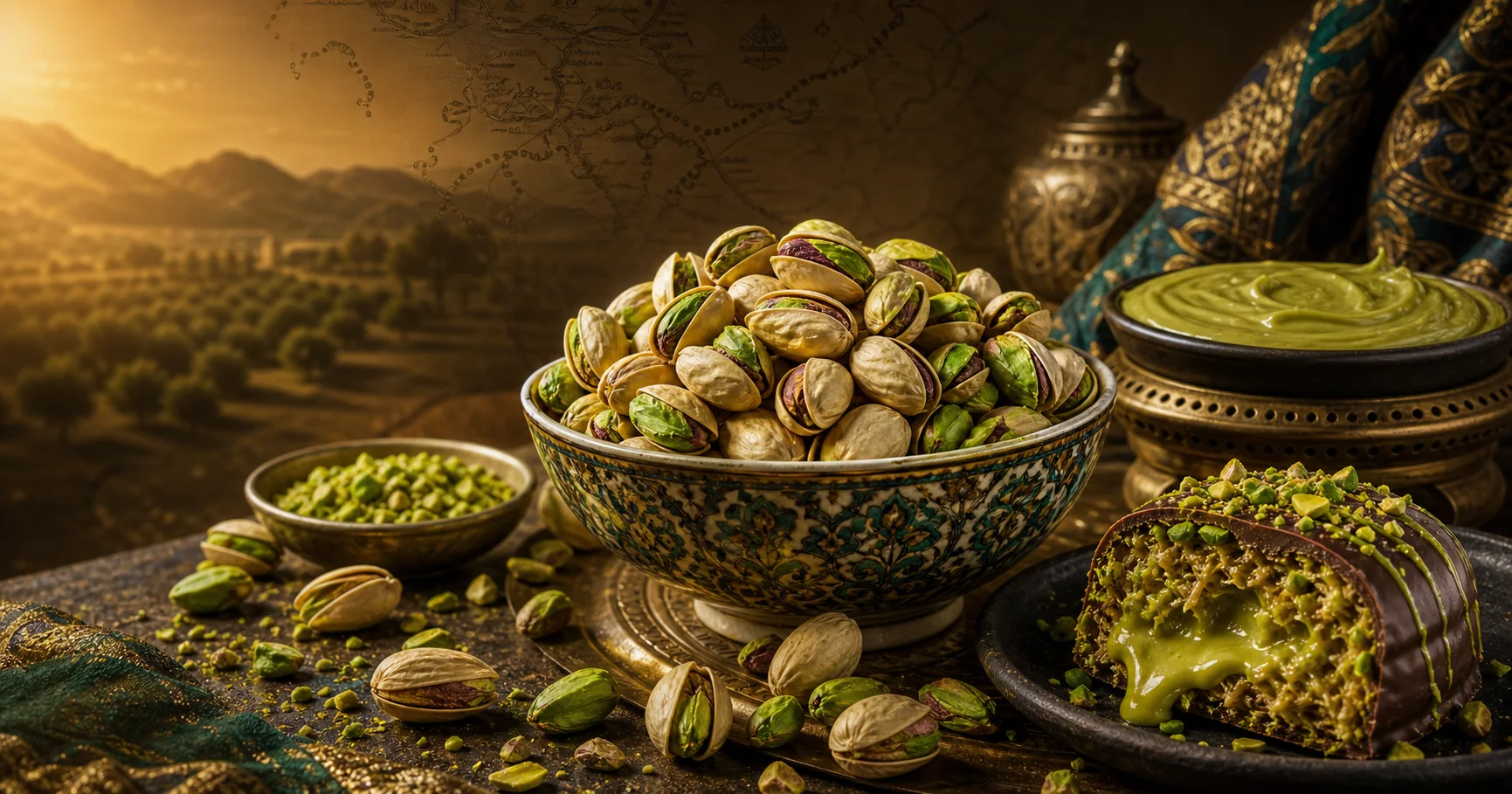
How Did Pistachio Become Green Gold?
Market and economic context review: Amine Naini — Reviewed against cited public sources for: Pistachio supply chains, scarcity pricing, luxury positioning, and viral demand from Dubai chocolate.
Review lanes show the scope checked for this case file. Active standalone case files present source-led historical context.
How did pistachio become green gold?
Verdict: Pistachio became green gold because it combines ancient orchard scarcity, luxury color, pastry prestige, constrained supply, and modern viral demand. [1] [2] [3] [4]
Why it matters: Pistachio shows how an old tree crop can become a modern luxury signal when color, shortage, supply chains, and social media converge.
Why Green Gold Works as a Metaphor
Pistachio is called green gold because it behaves like a luxury commodity. [1]
Pistachio is called green gold because it behaves like a luxury commodity. It is visually distinctive, expensive to produce, tied to specific climates, and powerful in sweets. A small amount can change the status of a dessert because the color alone signals cost and care.
That makes pistachio different from a neutral nut. It carries scarcity in its appearance.
Ancient Orchards Before Viral Chocolate
Pistachio's deeper history is rooted in dryland orchard regions connected to Iran, Central Asia, and the eastern Mediterranean. [1]
Pistachio's deeper history is rooted in dryland orchard regions connected to Iran, Central Asia, and the eastern Mediterranean. Trees take patience, land, climate, and labor. That makes pistachio a crop of investment, not instant abundance.
Older Persian, Mediterranean, and Islamic food cultures used pistachios in sweets, rice dishes, confections, and festive foods. The nut already carried luxury meanings long before modern chocolate bars discovered its camera appeal.
Dubai Chocolate and the Demand Shock
The viral Dubai chocolate format made pistachio cream highly visible: green filling, crunch, chocolate shell, and luxury packaging in one image. [1]
The viral Dubai chocolate format made pistachio cream highly visible: green filling, crunch, chocolate shell, and luxury packaging in one image. The Guardian reported in 2025 that this trend contributed to pistachio shortage concerns. That does not mean one dessert controls the entire world supply, but it shows how fast digital demand can hit a slow orchard crop.
Trees cannot respond to TikTok speed. That mismatch is the case file.
The New Luxury Nut Economy
Modern pistachio demand connects Iran, California, Turkey, pastry brands, chocolate makers, export markets, water risk, and visual food culture. [1]
Modern pistachio demand connects Iran, California, Turkey, pastry brands, chocolate makers, export markets, water risk, and visual food culture. The nut is old; the algorithmic demand curve is new.
The safest verdict is that pistachio became green gold because it sits at the crossroads of scarcity and spectacle. It tastes good, but it also photographs expensive.
Claim Graph
Evidence-Backed Claims
Each conclusion below carries a machine-resolvable proof path to the cited sources listed at the bottom of this page.