Is Truffle Oil Fake?
Market and economic context review: Amine Naini — Reviewed against cited public sources for: Luxury labeling economics, restaurant markup, and consumer-demand framing around truffle-flavored products.
Review lanes show the scope checked for this case file. Active standalone case files present source-led historical context.
Is truffle oil fake?
Verdict: Many commercial bottles are flavored oils rather than oils containing substantial truffle. That is not automatically fraud when the ingredient list says so. The problem begins when presentation implies fresh truffle, a named species, or natural provenance that the product does not support.
Why it matters: The case separates chemistry from deception. Manufactured flavor is not automatically unsafe or dishonest; unclear labels and unsupported luxury suggestions are the evidence-led concern.
Define “Fake” Before Reaching a Verdict
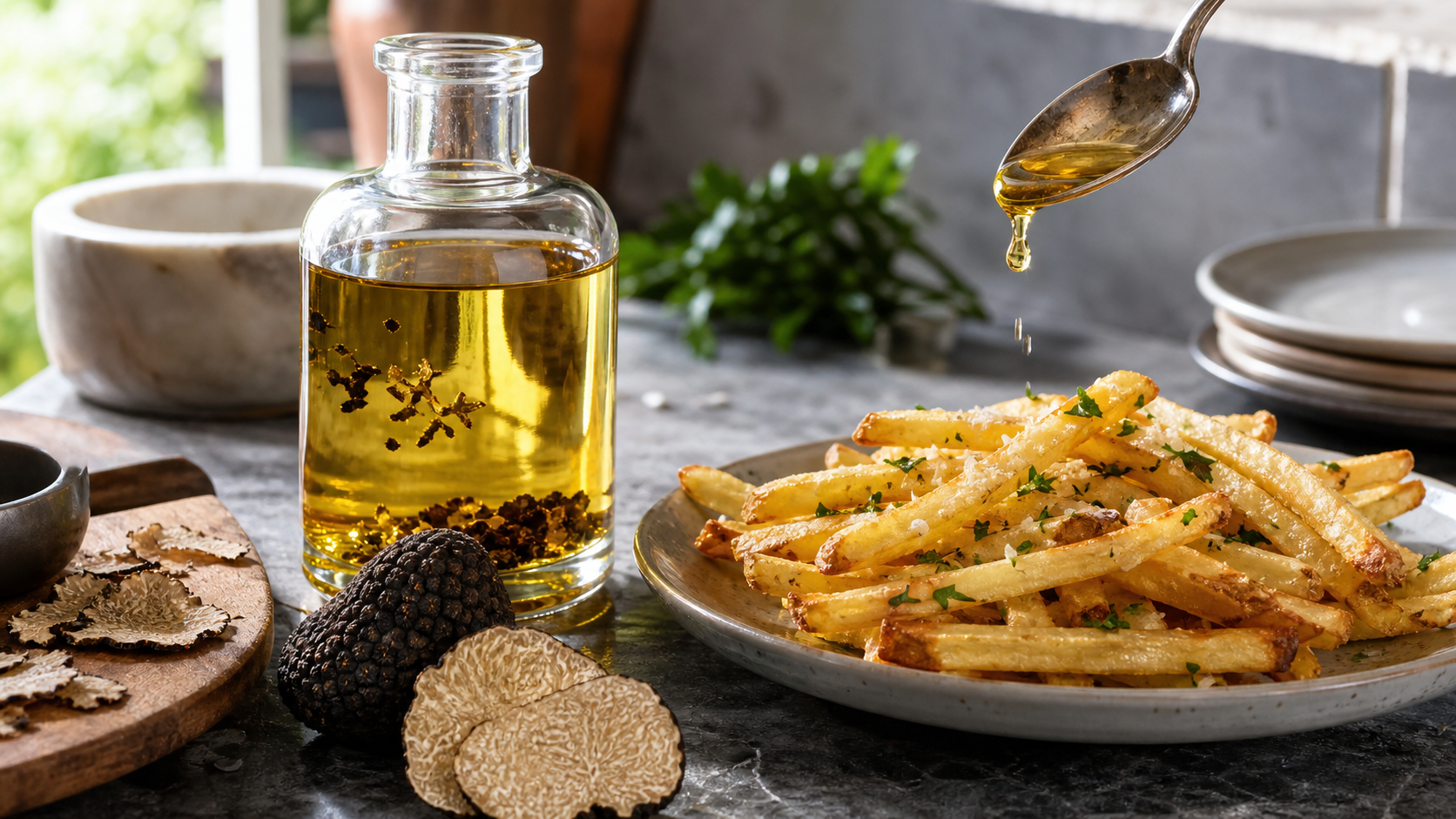
Truffle oil is a carrier oil flavored to smell or taste like truffle. It is not oil pressed from a truffle. A product may contain real fungus, extracted natural aroma, manufactured flavor compounds, or some combination. The front label and ingredient list determine whether that composition is honestly represented.
If a bottle clearly says “truffle-flavored oil” and lists flavoring, calling it counterfeit is too broad. If packaging implies that fresh truffle or a named *Tuber* species supplies the aroma when evidence or ingredients say otherwise, “misleading” becomes a defensible criticism. This case therefore evaluates the promise, not merely the presence of chemistry.
What Commercial-Oil Research Found
A study published in *Food Control* examined the volatile profiles and labels of commercial truffle-flavored oils. It found widespread added aroma compounds and reported inconsistencies between some products’ chemical profiles, stated truffle species, and presentation [1]. That is stronger evidence than repeating a chef’s dislike of truffle oil.
The analysis does not prove that every bottle is fraudulent. It shows why shoppers cannot infer composition from a photograph of a truffle or from visible fragments in the oil. A small piece can contribute appearance while added flavor supplies the dominant smell. Conversely, a product can be a legitimate flavored oil without containing expensive fresh fungus if it says so plainly.
What 2,4-Dithiapentane Can and Cannot Prove
2,4-dithiapentane is a sulfur-containing volatile strongly associated with the smell of Italian white truffles. It can occur in natural truffle aroma and can also be manufactured for use in flavoring [2][3][4]. Detecting or naming the molecule does not by itself establish where it came from.
The compound can produce a powerful, recognizable note, but fresh truffle aroma contains a much broader mixture influenced by species, maturity, microbes, storage, and environment [4]. An oil built around one dominant compound may smell immediately “truffly” while lacking the complexity of fresh shavings. That makes it a flavor formulation, not automatically a safety problem or a counterfeit food.
How Restaurant Prestige Complicates the Claim
Fresh truffles are seasonal, perishable, difficult to cultivate, and expensive. Flavored oil carries the aroma signal at far lower cost. Restaurants used that difference to turn familiar foods such as fries, popcorn, pasta, and eggs into premium menu items. Hot fat helps release volatile compounds, making a few drops conspicuous.
A markup is not proof of fraud; restaurants charge for preparation and experience as well as ingredients. The relevant question is whether a menu promises fresh truffle, a named species, or a quantity it does not deliver. “Truffle fries” can mean fries flavored to evoke truffle, but extra claims should be supported.
A Practical Label Test
Read the ingredient list for the carrier oil, any named *Tuber* species, truffle percentage where supplied, and terms such as flavor, aroma, natural flavor, or artificial flavor. Do not treat visible fragments or a high price as independent authentication. The product’s direct statements should agree with one another.
This is also why “synthetic” should not be used as a synonym for poisonous. Origin and toxicity are different questions, and this case makes no medical claim. The source-led concern is whether a shopper can tell the difference between fresh truffle, truffle-containing oil, naturally derived aroma, and manufactured flavor.
Final Finding
Many commercial truffle oils obtain much of their recognizable aroma from added flavor compounds rather than substantial fresh truffle [1][2]. Calling every one of them fake is inaccurate when labels clearly describe a flavored oil. Calling them equivalent to fresh truffle is also inaccurate. The compound name alone cannot settle whether the aroma was naturally derived or manufactured.
The fair verdict is conditional: honestly labeled flavored oil is a distinct product; unsupported suggestions of rare fungus or natural provenance deserve scrutiny. The full [truffle oil history](/food/truffle-oil) explains the biology, chemistry, restaurant economics, and label-reading context behind that conclusion.