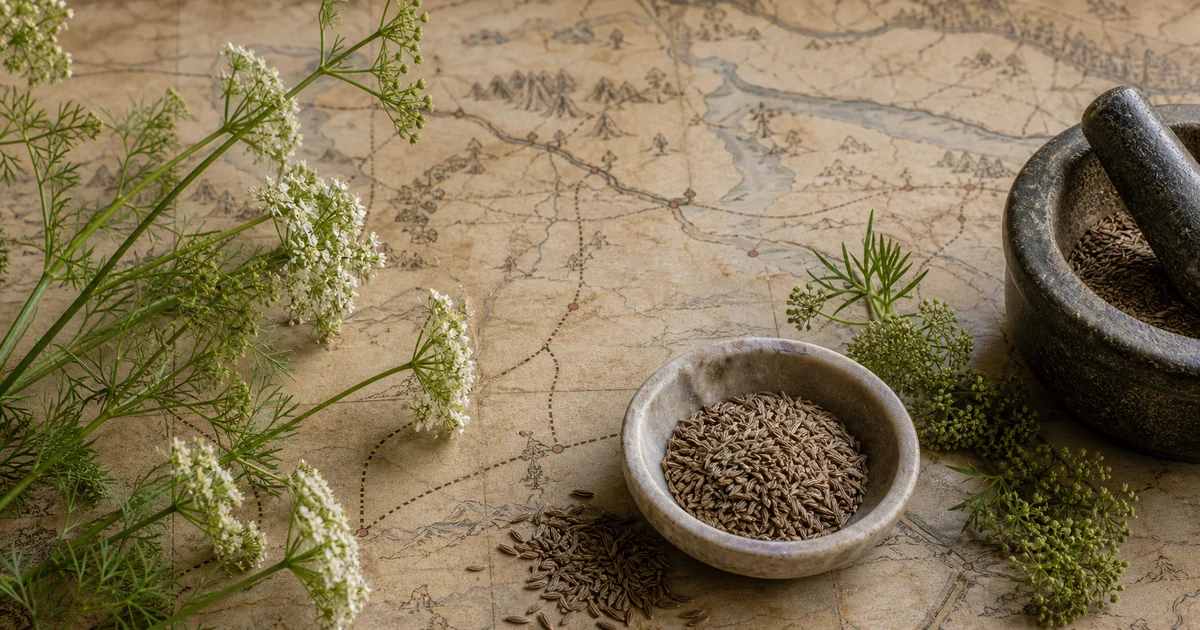
Cumin seeds and flowering Cuminum cyminum plants beside an ancient trade map
Image: The Foods That Shaped Us Research Desk · License

Cumin History: Ancient Seeds, Caravan Routes, and the Spice That Crossed Continents

How a West Asian and Mediterranean seed moved through early agriculture, Egyptian and Roman kitchens, Islamic trade, South Asian spice systems, colonial migration, and modern blends

📍 West Asia and eastern Mediterranean cultivation zone📅 Cultivated in antiquity; exact first domestication remains debated7 min read
Published: ·Updated: ·
Source and factual review: Mehdi IarabCumin taxonomy, archaeobotanical evidence, trade chronology, and cautious origin framing.
Cumin History: Ancient Origins and Global Spice Routes

💡 Key Takeaways

  • Cumin was cultivated in West Asian and Mediterranean antiquity.
  • Archaeobotanical finds show use, but one exact invention place is not secure.
  • Islamic-era agriculture and trade helped move cumin across connected regions.
  • Spanish and Portuguese imperial routes later carried cumin into many American cuisines.

What Is Cumin?

Cumin is the aromatic dried fruit of Cuminum cyminum, a member of the parsley family. Its warm, earthy flavor appears in whole and ground form across West Asian, North African, South Asian, Central Asian, Mediterranean, Latin American, and other cuisines [1].

It is not caraway, black cumin, or Nigella, though names have overlapped in translation.

Ancient Evidence Without a Single Birthplace

Seeds and texts place cumin in ancient West Asian, Egyptian, and Mediterranean food and medicine. Archaeobotanical evidence shows use at particular sites, but it does not identify one first farmer or one national origin [2][4].

The plant’s history is better understood as cultivation across connected dryland regions than as a modern border claim.

Greek, Roman, and Medieval Uses

Classical writers described cumin in sauces, breads, medicines, and appetite. Medieval Islamic agriculture and commerce connected producing regions with urban markets from Iberia and North Africa to West and South Asia [2][3].

Cumin’s value came from portability: a small dry seed could carry intense flavor across long caravan and maritime routes.

Cumin Crosses the Atlantic

Iberian colonization and migration carried cumin into the Americas, where it entered local combinations with Indigenous chilies, maize, beans, meats, and regional herbs. Later migrations added further layers [3][4].

Its presence in Mexican or Tex-Mex food is therefore historical, but not proof that every Mexican region uses it equally.

Cumin Today

Cumin anchors garam masala, baharat, chili powders, adobos, soups, rice, breads, cheeses, meats, and vegetable dishes. India is a major producer and consumer, while climate and price volatility affect global supply.

The seed’s broad distribution should not flatten cuisine. Its history is one of repeated localization: every region fitted an ancient traveler into a different flavor grammar.

📜 Informational & Historical Context NoteHistorical systems of medicine, traditional remedies, and herbal applications discussed on this page (such as ancient Ayurvedic, Greek, or Egyptian practices) are presented purely for historical interest and cultural context. They are not intended as, and must not be taken as, modern medical or dietary advice. Always consult a qualified healthcare professional before making any wellness or nutritional decisions. Read our full Disclaimer.

Historical Timeline

Bronze-Iron Age

Cumin appears in archaeological and textual contexts across West Asia and the eastern Mediterranean

Classical era

Greek and Roman cooks and medical writers describe cumin

Medieval period

Islamic agricultural, medical, and culinary networks circulate cumin widely

16th century onward

Iberian colonial migration helps establish cumin in American cuisines

🎉 Fun Historical Facts

  • The culinary cumin “seed” is botanically a dry fruit.
  • Cumin and caraway look similar but are different plants.
  • Its aroma intensifies when seeds are toasted and ground.

📚 Sources & References

  1. [1]Cuminum cyminum. Kew Science, Plants of the World Online (2024).
    Search Source
  2. [2]Andrew Dalby. Food in the Ancient World from A to Z. Routledge (2003).
    Find Book
  3. [3]Andrew Dalby. Dangerous Tastes: The Story of Spices. University of California Press (2000).
    Find Book
  4. [4]Kenneth F. Kiple and Kriemhild Coneè Ornelas, eds.. The Cambridge World History of Food. Cambridge University Press (2000).
    Find Book

Articles are reviewed internally for source quality, historical context, clarity, and relevance. Our references may include academic books, university-press publications, museum records, archaeological studies, peer-reviewed journals, historical archives, official cultural institutions, and established food-history works. Case file links point to supporting evidence.

Evidence Explorer

Review the Source Trail

Inspect the article sources, scoped review credits, and copyable citation details without leaving the page.

Reviewed for Stated Scope

Source and factual review: Mehdi IarabCumin taxonomy, archaeobotanical evidence, trade chronology, and cautious origin framing.

Sources Listed

[1] Cuminum cyminumKew Science, Plants of the World Online (2024)

[2] Andrew Dalby. Food in the Ancient World from A to ZRoutledge (2003)

[3] Andrew Dalby. Dangerous Tastes: The Story of SpicesUniversity of California Press (2000)

[4] Kenneth F. Kiple and Kriemhild Coneè Ornelas, eds.. The Cambridge World History of FoodCambridge University Press (2000)

🏛️

Written by The Foods That Shaped Us Research Desk

The Foods That Shaped Us Research Desk is the publication byline for legacy and collaboratively maintained food-history articles. Articles are researched and edited through a publication-led process, grounded in cited sources, and reviewed for historical context, source quality, and clarity.

Comments

Community comments are coming soon. Check back later to join the discussion!
Related Foods