💡 Key Takeaways
- No single person invented flour: grinding seeds and grains into powder is a Paleolithic technology documented tens of thousands of years before farming.
- Late Natufian communities in the southern Levant used rock-cut conical mortars to produce fine wild-barley flour about 12,500 years ago — before full cereal domestication.
- Industrial roller mills in the nineteenth century made cheap white flour the global default; enrichment later restored vitamins lost when bran and germ were stripped away.
Who Invented Flour?
Nobody invented flour. Google-style queries such as "who invented flour" imply a named genius with a patent date. Food history does not work that way. Flour is a process: pounding or grinding seeds, roots, tubers, or cereals into a powder fine enough to cook as porridge, flatbread, or dough. That process appears wherever foragers had hard plant foods and stone tools — long before cities, bakeries, or branded paper bags [1][4].
What most searchers mean is wheat flour for bread. Even then, there is no inventor. Domestication of wheat in the Fertile Crescent and the later crafts of milling, bolting, and enrichment created a continuum from coarse meal to industrial white flour. Oxford and Cambridge food histories treat flour as infrastructure — the milled middle between field and loaf — not as a single invention event [1][2].
From a search-quality standpoint, the best answer is also the accurate one: flour has no founder. It has an archaeological timeline measured in tens of thousands of years, then a technological timeline of querns, water mills, and roller mills. Ranking pages that invent a fake "inventor of flour" fail helpful-content standards; this page answers the query by correcting it [7].
The same correction applies to related myths. Flour was not discovered in one kingdom, patented in one century, or gifted by one culture to the world. Multiple regions developed grinding independently because hard seeds reward the same mechanical solution: stone against stone, then sieve against bran.
Where Did Flour Come From? Paleolithic and Natufian Evidence
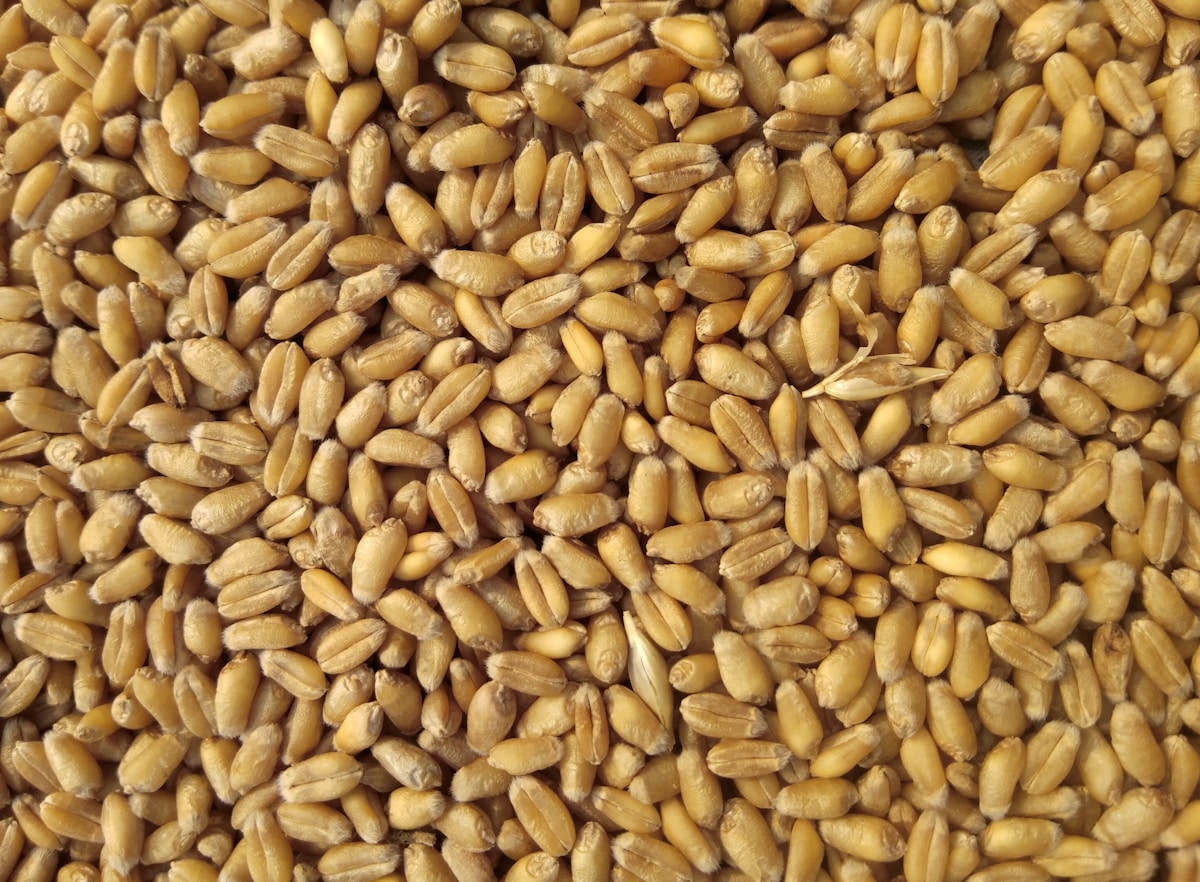
The earliest direct evidence for processing wild cereals into flour-like products comes from starch grains on Upper Palaeolithic ground stone. At Ohalo II on the Sea of Galilee, Piperno and colleagues recovered starch from a grinding tool associated with wild barley and possibly wheat — evidence that foragers pounded and ground hard seeds long before farming, and likely cooked the results near hearth features [4]. That finding matters for the history of flour because it separates grinding technology from agriculture: people made powder from wild grain before they planted fields.
Closer to the Neolithic threshold, Late Natufian communities in the southern Levant used rock-cut conical mortars. Experimental archaeology published in PLOS ONE showed that those roughly 12,500-year-old mortars can efficiently dehusk and mill wild barley into fine flour — supporting unleavened bread and porridge before full cereal domestication [5]. The experiments matter because they turn silent stones into a reproducible food process: peel, grind, sieve, cook.
At Shubayqa 1 in Jordan, Arranz-Otaegui and colleagues documented bread-like foods from ground wild cereals about 14,400 years ago, tying flour-making to the same Natufian world that precedes agriculture [6]. Those finds sit beside a wider Near Eastern story in which sickles, storage, and sedentary camps made cereal processing worth the labor.
So where did flour come from? From grinding. The Fertile Crescent later supplied domesticated wheat and barley at scale, which made flour a civilizational staple rather than a forager technique. But the idea of flour — powder from seed — is older than the farm. When modern bakers talk about "ancient grains," they are often talking about varieties; the deeper antiquity is the millstone itself [2][5].
What Flour Is: Meal, Bolting, and the Word Itself
In kitchen English, flour usually means a fine powder from wheat, while meal can mean a coarser grind. Historically the line was social as much as technical: the "flower of the meal" was the finest bolted portion after bran and coarse particles were sifted away [1][8]. The English word flour is a spelling variant of flower, from Old French fleur — blossom and, figuratively, the finest part. Printers and dictionaries only fully separated flour and flower around 1830; before that, context told you whether a text meant a blossom or bolted wheat [8].
Harold McGee and standard food science emphasize that wheat flour's baking power depends on gluten-forming proteins in the endosperm. Milling choices — stone versus roller, extraction rate, ash content — change flavor, color, shelf life, and nutrition [3]. Extraction rate (how much of the kernel ends up in the bag) is one of the most useful technical ideas for readers: high-extraction and wholemeal flours keep more bran and germ; low-extraction white flours keep mostly endosperm.
Ash content, protein percentage, and particle size are the modern baker's shorthand for what medieval bolting cloths once did by hand. A strong bread flour is not better flour in the abstract; it is flour milled and selected for gluten work. Cake and pastry flours are milled and blended for tenderness. Semolina and durum products sit in a different grind family optimized for pasta and couscous rather than sandwich crumb [1][3].
Flour is also not only wheat. Oats, rye, barley, rice, maize, chickpea, and chestnut flours all have deep regional histories. Calling every powder "flour" is linguistically normal and botanically loose — which is why this page centers wheat flour as the global default while keeping the category honest [1][2].
Mills, Cities, and the Rise of White Flour
Once cereals were farmed, milling became infrastructure. Hand querns and saddle stones gave way to rotary querns; classical Mediterranean societies scaled production with animal- and water-powered mills. Roman cone mills and water-mill gearing fed urban bread systems — flour as logistics and politics, not only craft [1][2][7]. Cities that could not secure grain and milling capacity faced hunger and unrest; flour sat inside the same political economy as the annona and later medieval mill rights.
Egyptian and Near Eastern milling traditions long preceded Rome. Tomb scenes and archaeological mills show organized grain processing feeding temple, palace, and household economies. What Rome scaled was not the invention of flour but the urban demand for it: bakeries, grain fleets, and public bread politics all assumed a reliable milled product [2][7].
For nearly two millennia, stone milling plus bolting defined quality. White flour signaled status because removing bran took time and discarded calories that poorer households kept in darker loaves. Medieval and early modern Europe treated whiteness as class: fine bolted flour for elites, coarser meal for laborers [1][2]. That class signal survived into industrial advertising long after roller mills made white flour cheap.
The nineteenth-century roller mill — developed and commercialized especially in Hungary and Central Europe in the 1860s–1870s — changed the economics. Steel rollers separated endosperm from bran and germ more efficiently than close-set stones, yielding whiter flour with longer shelf life (less germ oil to go rancid) and higher recovery of the fraction customers preferred [1][7]. Within decades, roller milling displaced most commercial stone mills in industrializing regions.
That industrial white flour became the default for pasta factories, commercial bakeries, and home bags labeled all-purpose. It also stripped fiber and many micronutrients concentrated in bran and germ — a nutritional trade-off that public health later tried to reverse through enrichment rather than by returning everyone to wholemeal overnight.
Enrichment, Whole Grain, and Flour Today
In the 1930s–1940s, enrichment programs in the United States and elsewhere began restoring iron and B vitamins (thiamine, riboflavin, niacin) to refined flour; folic acid fortification expanded later in the twentieth century [7]. Enrichment is not the same as whole grain: it replaces selected nutrients lost in refining, not the full bran-and-germ package of fiber and oils. Understanding that distinction helps readers navigate labels that say "enriched" without meaning "whole wheat."
Public-health enrichment answered deficiency diseases linked to diets heavy in refined cereals. It did not erase the sensory and fiber differences between white and wholemeal flours, and it should not be read as proof that industrial white flour is nutritionally identical to stone-ground whole grain [3][7].
Meanwhile, stone-milled and high-extraction flours returned through artisanal baking, sourdough culture, and heritage-wheat movements that prize flavor, fermentation tolerance, and agricultural diversity over industrial whiteness [1][3]. Home bakers now choose protein percentages, ash numbers, and local mills the way earlier generations chose only "all-purpose" or "self-rising."
Today flour still sits at the center of bread, cakes, noodles, dumplings, and thickening sauces — and at the center of diet debates about gluten, ultra-processed food, and fiber. For The Foods That Shaped Us, this page closes a broken internal link: wheat already listed flour among related foods, but /food/flour did not exist. Flour is the milled middle chapter between grain fields and the loaf.
The trending yet rankable search phrases — who invented flour, history of flour, where did flour come from — all resolve to one story: a Paleolithic technique industrialized into a global staple, partially repaired by enrichment, and partially rediscovered by whole-grain and sourdough bakers. That is the history of flour search systems should prefer: sourced, specific, and honest about what nobody invented.
How Flour Connects Bread, Pasta, and Modern Baking
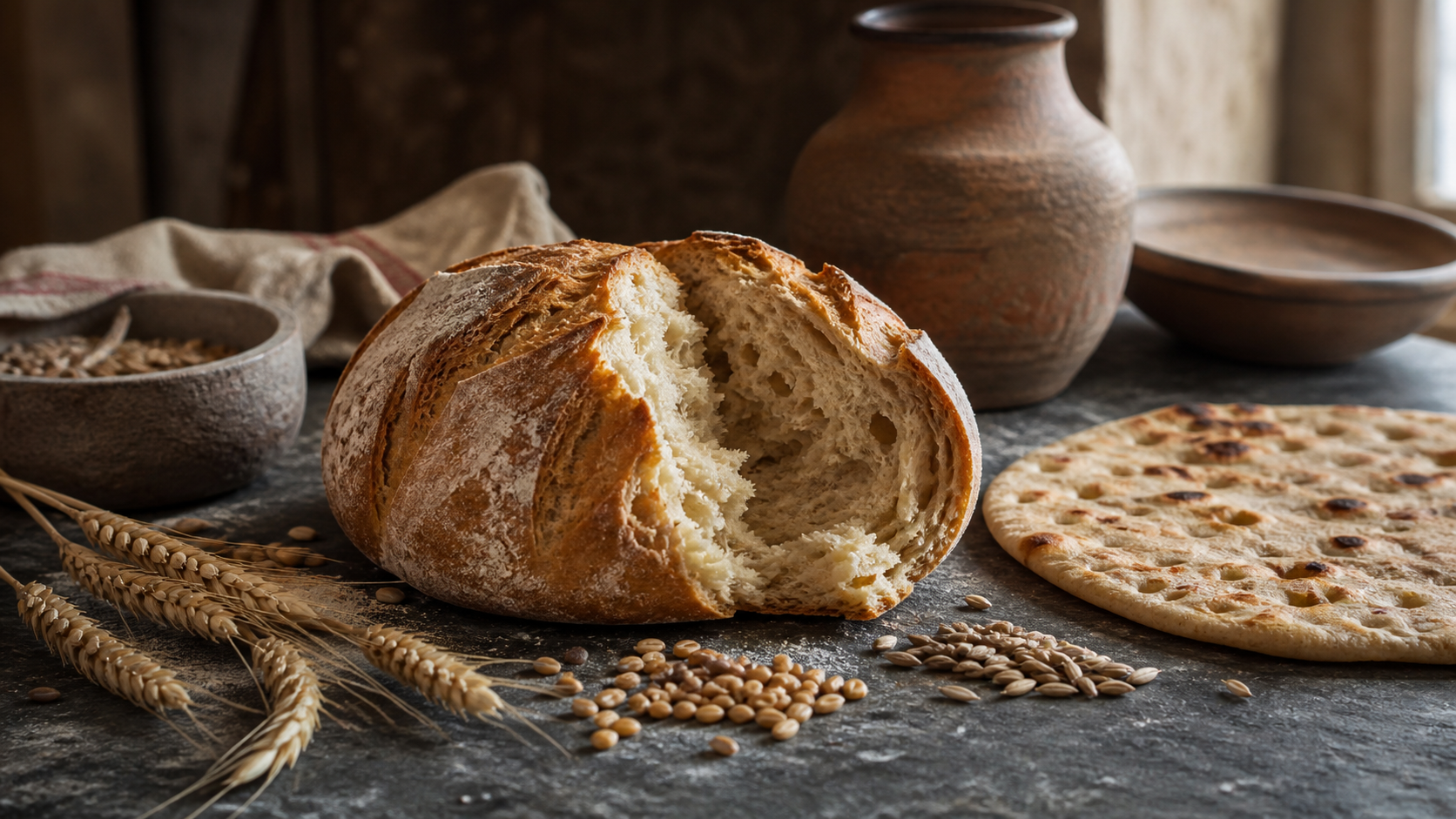
Flour is the shared ingredient behind foods that feel culturally separate. Bread depends on wheat flour's gluten network and on milling choices that change crumb and crust. Pasta historically leans on durum semolina — a coarser, harder-wheat grind optimized for drying and al dente bite rather than sandwich loaves [1]. Sourdough is not a different flour so much as a different leavening ecology working on flour and water; starter culture amplifies whatever the mill put in the bag [3].
Oats remind readers that not every flour behaves like bread wheat: oat flour lacks the same gluten architecture and belongs to porridge, baking blends, and modern oat-milk processing more than to high-rise sandwich loaves. Rye flour brings different pentosans and a denser crumb tradition across northern Europe. Chickpea and other pulse flours belong to flatbreads, batters, and regional fritters rather than pan loaves.
Mapping those differences is practical for readers searching "what is flour": they need taxonomy, not a recipe dump. All-purpose flour is a modern retail compromise; bread flour, pastry flour, "00," atta, and masa harina are each answers to different dough problems and food histories [1][3].
If you came here from wheat, stay for the mill. If you came from a "who invented flour" query, leave with a better question: who milled, who bolted, who industrialized, and who enriched — because those are the real chapters in the history of flour [2][7].
Historical Timeline
Starch residues on grindstones (e.g. Ohalo II) show wild cereal processing long before domestication
Natufian rock-cut conical mortars produce fine wild-barley flour in experimental archaeology reconstructions
Shubayqa 1 (Jordan) yields evidence of bread-like foods from ground wild cereals
Roman cone mills and Greek/Roman water-powered milling scale flour production for cities
English spelling splits "flour" from "flower"; flour keeps the sense of the finest part of meal
Hungarian and Central European roller mills industrialize white flour separation of endosperm from bran and germ
Enrichment programs add iron and B vitamins to refined flour to fight deficiency diseases
Folic acid fortification expands; heritage milling and whole-grain baking revive stone-ground flours
Evidence Explorer
Review the Source Trail
Inspect the article sources, scoped review credits, and copyable citation details without leaving the page.
Sources Listed
Comments
Community comments are coming soon. Check back later to join the discussion!