💡 Key Takeaways
- Spam is a brand of canned cooked pork and ham introduced by Hormel in 1937, originally a way to turn low-value pork shoulder into a shelf-stable, refrigeration-free protein.
- World War II made Spam global: the U.S. military bought over 100 million pounds and shipped it across the Pacific, where it entered local diets in Hawaii, Guam, the Philippines, Korea, and Okinawa.
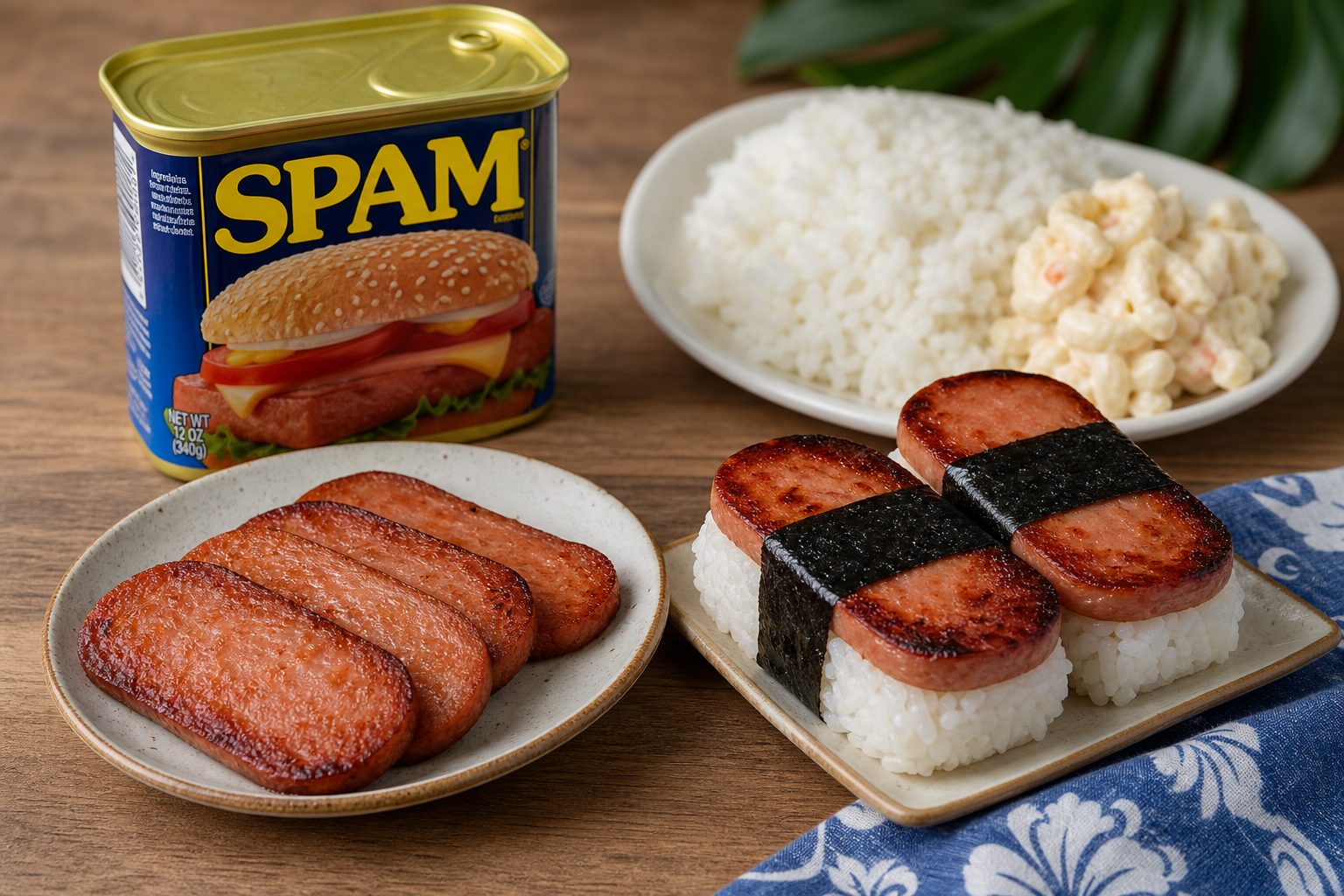
- Hawaii adopted Spam most deeply, turning it into everyday food and into Spam musubi — a slice of grilled Spam on rice wrapped in nori — now a convenience-store staple and island identity.
- Korea built budae-jjigae (army base stew) from postwar U.S. military surplus Spam and hot dogs, a dish that is now a comfort-food classic with its own history of scarcity and reinvention.
- Spam endures because it is shelf-stable, cheap, salty, and flexible — the same reasons the U.S. military chose it in 1941 — and it keeps finding new formats, including the 2026 Spam dog.
What Is Spam?
Spam is a brand of canned cooked pork and ham made by Hormel Foods, introduced in 1937. It is a shelf-stable rectangular can of spiced, minced pork and ham that slides out as a solid loaf, ready to be sliced and fried. Historically it is more than a food: it is a 20th-century industrial product whose military distribution reshaped Pacific food culture [1][2].
It sits beside the hot dog as an American processed meat that traveled the world, and beside pork as a preserved, salted, shelf-stable version of an ancient staple [3]. Like other preserved meats, Spam is a story about salt, shelf life, and the logistics of feeding people far from a kitchen — which is exactly why the U.S. military loved it.
How Hormel Invented Spam in 1937
Hormel introduced Spam on July 5, 1937, originally labeled "Hormel Spiced Ham" and soon shortened to Spam. Jay Hormel wanted a use for pork shoulder, then a low-value cut, and a product that did not need refrigeration [1][2]. The solution was a cooked, canned, shelf-stable pork-and-ham loaf.
The name's origin is debated — a portmanteau of "sp" (spice) and "am" (ham), or the winner of a Hormel naming contest — but the product was a Depression-era industrial answer to a clear problem: cheap protein, no fridge, long shelf life [2]. That answer would matter far more a few years later, when a global war needed exactly those properties.
World War II and the Pacific Supply Line
Spam's big break was World War II. The U.S. military bought more than 100 million pounds of Spam during the war because it was shelf-stable, portable, calorie-dense, and needed no refrigeration — ideal for the Pacific theater's long supply lines and tropical conditions [1][3].
GIs ate Spam constantly and famously tired of it. But across the Pacific — Hawaii, Guam, the Philippines, Korea, and Okinawa — Spam entered local diets as a wartime protein and stayed after the war. The same cans that bored American soldiers became a food anchor in places short on refrigeration and long on shipping distance from the mainland.
Why Spam Became Hawaiian
Hawaii adopted Spam most deeply. Far from the mainland, reliant on shipping, and shaped by wartime military provisioning, Hawaiian households turned Spam into everyday food: fried with rice and eggs for breakfast, pressed into musubi, and served in plate lunches [1][2].
Spam musubi — a slice of grilled Spam on a block of rice, wrapped in nori — is now a Hawaiian convenience-store staple and a piece of island identity. It is a postwar format that blends American canned meat with Japanese rice and nori, and it mirrors the portable shape of Japanese onigiri [3]. In Hawaii, Spam is not a joke; it is breakfast, lunch, and a picnic food.
Spam in Korea, the Philippines, and Beyond
Korea built budae-jjigae — "army base stew" — from postwar U.S. military surplus: Spam, hot dogs, and canned beans simmered with kimchi and gochujang. Born from scarcity around U.S. bases after the Korean War, it is now a comfort-food classic with its own history of reinvention [1].
The Philippines and Okinawa have their own Spam stews, stir-fries, and breakfast formats from the same military supply lines. Each is a case where military logistics became cuisine: a canned meat designed for an American factory and a global war turned into local dishes that outlasted both.
Spam Today
Today Spam is both a budget staple and a cult object — nostalgic, meme-friendly (the Monty Python sketch), and globally distributed, with limited-edition flavors and the Spam Museum in Austin, Minnesota [1]. The 2026 Spam dog trend is the latest format for a 1937 canned meat.
Spam endures because it is shelf-stable, cheap, salty, and flexible — the same reasons the U.S. military chose it in 1941. From WWII rations to Hawaiian musubi to Korean army stew to a viral hot dog, Spam keeps finding new formats because the original problem it solved, refrigeration-free protein that travels, never went away.
In the news
Recent 2026 food-culture notes that reference this article.
Historical Timeline
Hormel introduces "Hormel Spiced Ham," later shortened to Spam, as a shelf-stable canned pork product.
Spam spreads through U.S. stores as a Depression-era refrigeration-free protein and a cheap wartime-ready food.
World War II: the U.S. military buys over 100 million pounds of Spam and ships it across the Pacific, where it enters Hawaiian, Filipino, Korean, and Okinawan diets.
Spam stays in the Pacific after the war, filling protein gaps in Hawaii and becoming everyday island food: fried with eggs and rice, and pressed into musubi.
Korea builds budae-jjigae (army base stew) from U.S. military surplus Spam and hot dogs; the Monty Python Spam sketch cements the food in pop-culture memory.
Spam musubi becomes a Hawaiian convenience-store staple, and Spam grows into a global, limited-edition-flavor brand with a Hormel museum in Austin, Minnesota.
The Spam dog — a grilled Spam slice in a hot-dog bun — trends as a surprise summer food, the latest format for an 88-year-old canned meat.
Evidence Explorer
Review the Source Trail
Inspect the article sources, scoped review credits, and copyable citation details without leaving the page.
Sources Listed
Comments
Community comments are coming soon. Check back later to join the discussion!