💡 Key Takeaways
- Kataifi is a fine thread pastry made from a thin flour-and-water batter; it is pastry, not a grain noodle.
- The common label "shredded phyllo" is useful shopping shorthand, but kataifi threads are traditionally formed from batter rather than cut from finished phyllo sheets.
- Its history belongs to a wider family of medieval qatayef and kadayıf sweets, with tel kadayıf documented in Ottoman cookery by the fifteenth century.
- Knafeh, Turkish künefe, and Greek kataifi use related pastry threads in different regional forms; no single modern dessert represents the whole tradition.
- Dubai chocolate made kataifi newly searchable worldwide, but the ingredient and its crisp-syrup pastry culture are centuries older than the viral bar.
What Is Kataifi?
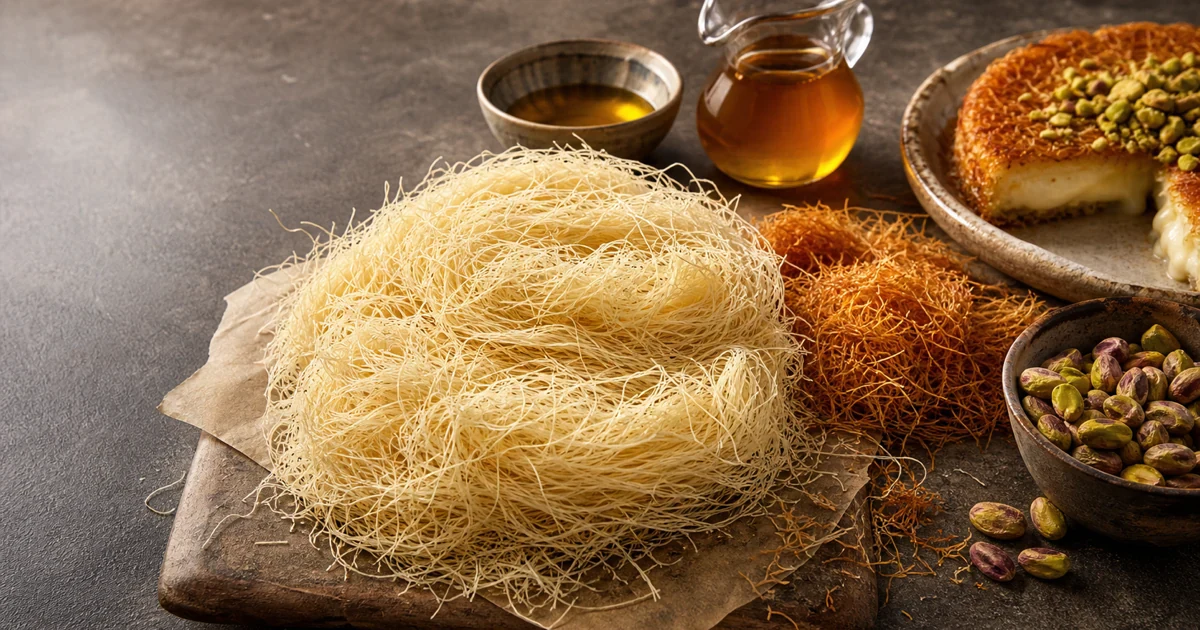
Kataifi is a fine, thread-like pastry made from a thin flour-and-water batter. The batter is streamed in hair-thin lines onto a hot rotating surface, where it sets almost immediately into long, flexible strands. Bakers gather those strands into loose bundles that can be wrapped around nuts, layered around cheese, pressed into trays, soaked with syrup, or toasted until crisp. The ingredient is known by several related spellings, including kataifi, kadaif, kadayif, and the Turkish kadayıf [1][3].
The first thing to understand is that kataifi is pastry, not pasta. Its raw strands can resemble vermicelli or angel-hair noodles, but they are designed for butter, baking, frying, and syrup rather than boiling in water. The distinction matters because modern search results often collapse every thin food strand into a noodle. Kataifi belongs to the pastry kitchen: flour becomes a fragile structure that can hold fat, nuts, cheese, cream, and syrup.
Kataifi is also an ingredient and a family name. In English-language shops, "kataifi dough" usually means the pale raw threads sold fresh or frozen. Across Turkish, Greek, Arab, Balkan, Armenian, and Levantine food cultures, closely related names can refer to the thread pastry, to a finished syrup sweet, or to a broader group of desserts [1][2]. Context determines whether a cook is buying the strands, baking a rolled Greek kataifi, or serving a cheese-filled künefe.
That flexibility is the reason kataifi has survived. The threads can become crisp on the outside and remain tender where they touch syrup or filling. They create contrast without requiring a thick crust. Long before a chocolate bar made the crunch famous online, pastry makers were using the same physical trick to turn flour, butter, sugar, nuts, and cheese into ceremonial and everyday sweets.
Is Kataifi the Same as Phyllo Dough?
Kataifi is often sold as "shredded phyllo," and the phrase is useful when a shopper needs to find it in a freezer case. Technically, however, the label is incomplete. Sheet phyllo is a dough rolled or stretched into broad, paper-thin leaves. Traditional kataifi begins as a pourable batter that is streamed directly onto a hot surface in separate threads. The final ingredients can be similar, but the forming process and structure are different [1][3].
That difference affects how the pastries behave. A phyllo sheet creates flat layers with broad contact between dough and fat. Kataifi creates thousands of narrow edges and air spaces. Butter or clarified butter coats the strands; oven heat then turns the exposed surfaces crisp while the interior can hold syrup, cheese, nuts, or cream. This high surface area is why toasted kataifi produces such an audible crunch in Dubai pistachio chocolate.
Commercial manufacturing can make the category look more uniform than it is. Modern machines meter batter onto a heated rotating drum, gather the cooked web, and package it into coils or nests. Recipes and flour blends vary among producers, and some packages use the language of filo or phyllo because international shoppers recognize it. "Shredded phyllo" is therefore a translation strategy as much as a production description.
For cooks, the practical distinction is simple. Do not treat raw kataifi like dry noodles, and do not expect it to behave like a stack of phyllo sheets. It dries quickly when exposed to air, so it is usually kept covered while being separated and shaped. Fat helps the strands brown evenly and remain distinct. Syrup is generally added according to the finished dessert's temperature and regional method, not poured indiscriminately. The craft lies in preserving the strands' lightness while giving them enough fat and heat to become crisp.
Where Did Kataifi Originate?
Kataifi does not have a responsible one-country, one-inventor origin story. Its vocabulary and techniques developed across connected medieval and Ottoman food worlds where cooks, merchants, court kitchens, religious communities, and urban pastry makers exchanged ingredients and methods. The most defensible history separates the older family of qatayef or kadayıf batter sweets from the later, clearly documented thread form known in Turkish as tel kadayıf [1][4].
Medieval Arabic cookery used names in the qatayef family for small griddle-cooked batters that could be filled, folded, sweetened, or served with nuts and syrup. Those foods are related by word history and dessert logic to later kadayıf traditions, but they were not automatically the same nest of fine threads sold as kataifi today. Priscilla Mary Işın's work on Ottoman sweets emphasizes this evolution rather than treating every historical spelling as an unchanged modern product [1].
The thread form becomes firmer in Ottoman culinary evidence. A 2023 literature review in the Journal of Multidisciplinary Academic Tourism reports tel kadayıf in a fifteenth-century cookbook associated with Muhammed bin Mahmud Shirvani. It also distinguishes the earlier flat kadayıf family from the threaded preparation [4]. In Turkish, tel means wire or strand, so the name identifies the feature that makes the ingredient recognizable.
This evidence supports an Ottoman chapter without turning a shared regional food into a nationalist trophy. The Ottoman Empire joined Anatolia, the Balkans, the Levant, Egypt, Greece, Armenia, and other culinary regions through movement, trade, taxation, migration, and imperial institutions. Techniques circulated through that geography and were localized. Greek kataifi, Turkish tel kadayıf and künefe, and Arab knafeh traditions are not copies of one modern master recipe; they are connected regional histories.
The accurate answer to "where did kataifi originate?" is therefore layered: its naming has medieval Arabic roots, its thread form is securely documented in Ottoman cookery, and its living traditions belong to multiple eastern Mediterranean and Middle Eastern cuisines.
From Qatayef to Tel Kadayıf: Why the Name Is Complicated
Food names rarely obey modern borders, and the qatayef-kadayıf-kataifi family is a particularly good example. The words traveled through Arabic, Ottoman Turkish, Greek, Balkan, and European-language contexts while the foods themselves changed shape. A historical text can use a familiar-looking name without describing the exact product a twenty-first-century shopper expects [1][2].
Qatayef today often means small stuffed pancakes associated especially with Ramadan in Arab food cultures. Kadayıf in Turkish can describe several shredded, flat, or bread-like syrup sweets, with tel kadayıf specifying the fine threads. Kataifi in Greek and international retail commonly names both the raw thread pastry and a finished rolled sweet filled with nuts and soaked in syrup. Knafeh and künefe add another layer: those names usually identify composed desserts whose bases vary by city, region, and period, sometimes using thread pastry and sometimes other forms.
This is why simple etymology cannot prove a simple invention claim. Similar words show relationship and exchange; they do not show that every form appeared simultaneously or remained unchanged. The fifteenth-century tel kadayıf reference is important precisely because it adds a material description to the name. It tells us that a strand form was present, not merely that the word kadayıf existed [4].
The 1844 cookbook Melceü’t-Tabbâhîn gives the history another firm point. Written by Mehmed Kâmil and recognized as the first printed Turkish cookbook, it went through repeated editions and became influential in later Ottoman cookery [5]. Studies of its dessert chapters identify several kadayıf preparations, while the historical review by Servet Güney describes ordinary, palace, white, and cream versions of tel kadayıf cooked with clarified butter and served with syrup [4][6].
Taken together, the documents show continuity without sameness. Batter sweets became specialized; strand pastry acquired named forms; regional kitchens built distinct desserts around it. Modern kataifi is not a fossil from one medieval recipe. It is the surviving technology of a changing pastry family.
How Kataifi Is Made
The visual drama of kataifi begins with an economical batter. Flour and water form the base, though commercial and regional formulas may adjust starch, salt, oil, acidity, or other processing details. What transforms the batter is not an exotic ingredient but controlled delivery: many fine streams hit a hot moving surface and set before they merge into a sheet [1][3].
Traditional and small-scale demonstrations often use a perforated container or a controlled pour over a heated metal surface. Industrial equipment turns the same principle into continuous production. A drum rotates under rows of tiny batter streams; heat cooks the underside just enough for the threads to release; workers or machinery gather the web into soft bundles. The pastry is only partly cooked at this stage. It remains pale and pliable so a baker can shape it around a filling.
The raw strands are delicate because their advantage is also their weakness. Their enormous surface area creates exceptional crispness, but it also lets moisture escape quickly. Once opened, kataifi is usually kept under a clean damp towel or plastic covering while the cook loosens small portions. Pulling too aggressively can compact the web; leaving it exposed can turn it brittle before shaping.
Fat is structural, not merely flavorful. Melted butter, clarified butter, or another recipe-specific fat coats the fine surfaces, encourages even browning, and keeps neighboring strands from forming a dry mass. Baking, pan-cooking, or toasting then develops the golden crust. In syrup sweets, the balance between crisp pastry and absorbed syrup depends on timing, temperature, and quantity.
Modern Dubai-chocolate fillings use a different final step. The kataifi is chopped or separated, toasted until crisp, and mixed with pistachio cream and often sesame tahini. It no longer forms the outer pastry shell; it becomes a crunchy inclusion. That adaptation looks new, but it still relies on the old engineering of fine strands and fat.
Knafeh, Künefe, and Ottoman Dessert Culture
Kataifi's most important historical life is not as an empty package of dough. It is as the architecture of finished desserts. In Turkish künefe and many forms of Levantine knafeh, strands can surround or support a cheese layer before the pastry is cooked, soaked with syrup, and finished with pistachios. Other versions use cream, nuts, or different pastry bases. The names, cheeses, colors, pan methods, and textures vary substantially by region [1][2].
That variation is worth protecting. "Knafeh" should not be reduced to one standardized internet image, and not every knafeh is made with the exact supermarket ingredient marketed as Greek kataifi. Palestinian, Lebanese, Syrian, Jordanian, Turkish, Egyptian, Greek, Armenian, and Balkan traditions developed their own expectations. Some prize a fine crisp surface; others emphasize soft cheese, semolina, cream, orange-blossom aroma, or a particular syrup balance.
Ottoman dessert culture helped create conditions in which such pastries could become specialized urban crafts. Sugar, honey, clarified butter, flour, nuts, dairy, rosewater, and professional ovens connected palace kitchens, guilds, markets, households, and religious celebrations. Melceü’t-Tabbâhîn matters because it captures this world in print at a moment when manuscript and professional knowledge were entering a broader cookbook culture [5][6].
Greek kataifi sweets often wrap the threads around chopped nuts before baking and syruping. Turkish tel kadayıf can be laid in a tray with nuts, cooked on a metal surface, and served in cut portions. Künefe uses cheese and is commonly cooked in shallow round pans. These are relatives, not interchangeable labels.
The shared principle is contrast. The pastry's thin outer surfaces brown and crackle; syrup softens selected layers; cheese or nuts provide density. That contrast made kataifi valuable long before digital video could amplify the sound. It also explains why the ingredient crossed languages and borders: a simple batter could carry local fats, nuts, dairy, aromatics, and ideas of celebration.
Why Kataifi Became the Crunch in Dubai Chocolate
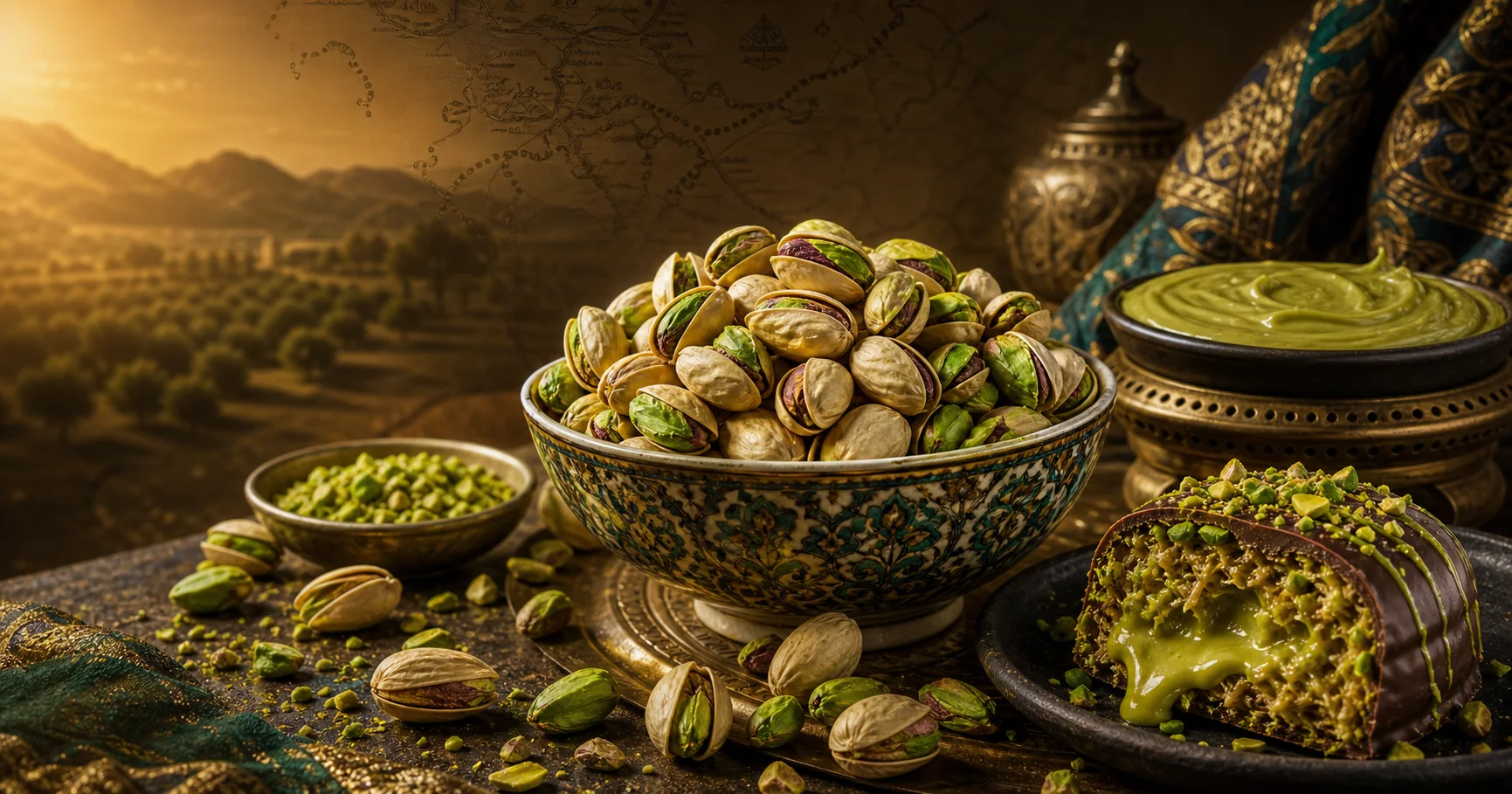
Dubai chocolate did not invent kataifi, but it changed the ingredient's global visibility. The bar associated with FIX Dessert Chocolatier combined a thick chocolate shell with pistachio cream, tahini, and toasted kataifi inspired by knafeh. Created in Dubai in the early 2020s, the format exploded through social video because it offered several signals at once: a dramatic cross-section, bright green filling, luxury-coded pistachio, and an audible crunch [7].
The Associated Press reported that the original format spread far beyond bars into croissants, milkshakes, cakes, dates, ice cream, and other products. AP also reported a 1,234 percent year-over-year rise in U.S. unit sales of pistachio-filled chocolates for the period it examined, while noting that the category remained small compared with the entire chocolate market [7]. Those details keep the story in proportion: the growth was extraordinary, but "Dubai chocolate" had not replaced ordinary chocolate.
Kataifi was essential because it solved a texture problem. Pistachio cream and tahini are dense and smooth; milk chocolate melts smoothly. Without the pastry, the filling could feel monotonous. Toasted strands insert dryness, fracture, and sound. They make each bite visibly and audibly different. The Specialty Food Association's 2026 "SenseMaxxing" forecast identified intensified texture, aroma, color, and crunch as major product signals, which helps explain why the format fit the moment [8].
The trend also created confusion. Some coverage called kataifi noodles; some called it simply shredded phyllo; some implied that knafeh itself had been placed inside a bar. The more precise description is a modern confection using toasted thread pastry and flavors associated with knafeh. That wording gives credit to the older dessert tradition without pretending the chocolate bar is a direct historical form.
For this publication, the viral moment is useful only because it opens the older story. A reader searching "what is kataifi in Dubai chocolate?" should leave knowing not only what made the bar crunchy, but also why that crunch has fifteenth-century documentation and centuries of regional pastry craft behind it.
How Kataifi Is Used Today
Today kataifi appears in several culinary roles. It can be wrapped around walnuts, pistachios, almonds, shrimp, cheese, or cream; layered into trays; pressed around soft cheese for knafeh or künefe; formed into nests; baked as syrup pastry; or toasted and mixed into chocolate, praline, ice cream, cheesecake, and pastry fillings. Contemporary chefs also use it as a crisp coating for savory foods, though sweet preparations remain its strongest historical identity.
Buying the right product begins with the label. Fresh or frozen kataifi should look like a tangled mass of very fine pale strands rather than dried pasta. It is normally thawed according to the package directions, kept covered during shaping, and separated gently. A cook using it for a syrup dessert needs a recipe designed for kataifi because phyllo-sheet quantities and handling do not transfer automatically.
Its closest internal links explain its versatility. Sugar and syrup give many historical kataifi desserts their gloss and keeping quality. Butter or clarified butter controls browning and separation. Pistachio supplies color, fat, and prestige. Sesame enters the modern Dubai format through tahini. Chocolate gave the pastry a new global wrapper.
Kataifi also reveals how food trends can distort historical scale. The ingredient was not obscure in the regions that had long baked with it; it was obscure to many English-speaking supermarket shoppers. Viral chocolate did not rescue a forgotten pastry. It moved an established regional ingredient into a new commercial and algorithmic network.
That distinction is the lasting answer. Kataifi is neither a 2020s novelty nor one timeless national dish. It is a technique-rich pastry ingredient with medieval linguistic roots, secure Ottoman thread-form evidence, many regional dessert lives, and a modern second career as the crunch people recognize before they know its name.
Historical Timeline
Arabic qatayef and related kadayıf names describe a wider family of griddle-cooked and syrup-sweetened batter pastries rather than one modern thread product
A cookbook associated with Muhammed bin Mahmud Shirvani records tel kadayıf, establishing the thread form in early Ottoman culinary writing
Mehmed Kâmil publishes Melceü’t-Tabbâhîn, the first printed Turkish cookbook, with multiple tel kadayıf preparations
Thread pastry remains central to syrup sweets across Ottoman successor cuisines, including Turkish, Greek, Balkan, Arab, Armenian, and Levantine traditions
FIX Dessert Chocolatier combines toasted kataifi, pistachio cream, tahini, and chocolate in Dubai; social video turns the texture into a global sensation
Retailers and bakeries carry the Dubai-chocolate format into croissants, ice cream, cakes, dates, and other products while texture becomes a major specialty-food trend
Evidence Explorer
Review the Source Trail
Inspect the article sources, scoped review credits, and copyable citation details without leaving the page.
Sources Listed
Comments
Community comments are coming soon. Check back later to join the discussion!